|
|
|
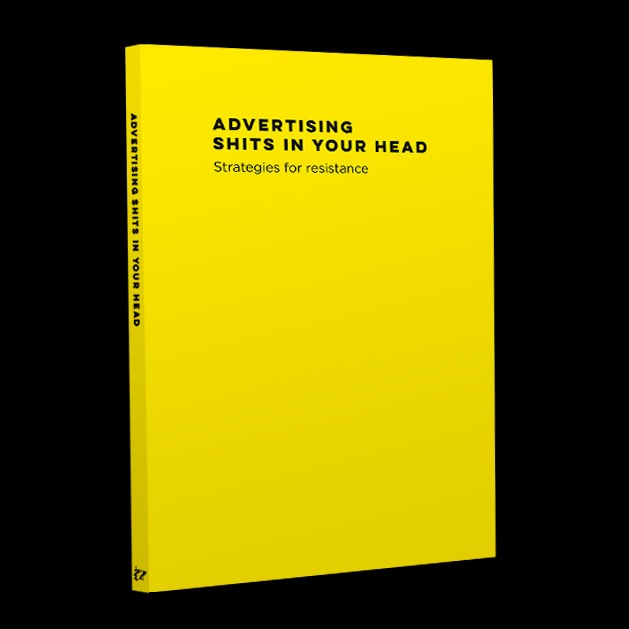
Advertising Shits In Your Head, US Edition.
Our good friends at PM Press have put together an American version of thier best selling "Advertising Shits In Your Head" UK publication. With Interviews, tutorials and insightful knowledge about advertising and its pernicious influence, ASIYH is a fantastic read and a great present for young minds and public space activists. If you can help support the Kickstarter campaign please do what you can to insure this publication makes it to press.
Advertising Shits in Your Head calls ads what they are—a powerful means of control through manipulation—and highlights how people across the world are fighting back. It diagnoses the problem and offers practical tips for a DIY remedy. Faced with an ad-saturated world, activists are fighting back, equipped with stencils, printers, high-visibility vests, and utility tools. Their aim is to subvert the ads that control us. More [ HERE] Labels: Books, Other Artists, PublicAdCampaign, subvertising, UK
Book review: Advertising Shits In Your Head
This book review is much better than I might write and is less biased for my lack of participation. :)
Advertising Shits In Your Head (no author is given), is a pocket-sized book, but it’ll burn a hole in any pocket you put it in. It’s a powerful tirade against advertising and what it does to our minds, to our culture, to our planet. But not content to sit and fulminate about it, it is a book that’s about action, about actively reclaiming our mental environment. As Banksy puts it: More [ HERE] Labels: activism, Books, brandalism, criticism, Other Artists, PublicAdCampaign, special patrol group
Strategies For Resistance
Order yourself and advanced copy [ HERE]
Advertising Shits In Your Head combines theory and practice in one short book about the modern subvertising movement. Featuring: Public Ad Campaign, Brandalism, Special Patrol Group and Dr. D.
Expected delivery: January 2017
Read a sample chapter: Advertising Shits in Your Head - Chapter 1
Advance praise for Advertising Shits In Your Head:
_
“Have you ever stopped to wonder why you know so much about things you are not interested in: brands, products, courses, colleges, holidays you might take, clothes you should wear? You may think yourself immune, but advertising is subliminal. You might ignore the Facebook posts that are ‘sponsored’, the animated billboards, and you may always skip the adverts as fast as you can. But to ignore them you first had to recognise them for what they were. And even in that small instance of time a logo has seeped into your subconscious. If advertising didn’t hit the target it would not be made. You are the target." – Danny Dorling (Author)
"Advertising Shits In Your Head provides a history of the practice (going back to the early 70s), alarming research and theory on the effects of the industry, advice about how to take part (including legal information) as well as several stunning case studies. This is essential reading for all who want to fight back against 'the most powerful and sustained system of propaganda in human history'.” – Jamie Kelsey-Fry (Contributing-Editor, New Internationalist)
"Advertising Shits In Your Head concisely describes, through unique first-hand accounts, the range of concerns adressed by today's subvertising community. From a right to the city argument, to the belief that advertising is the biggest obstacle to avoiding catastrophic climate change, Advertising Shits In Your Head envisions a movement looking far beyond culture jamming and corporate identity sabotage." – Jordan Seiler (Public Ad Campaign)
"Advertising Shits in Your Head gives form and context to culture jamming practices in the 21st Century. It is an important contribution on the path to realising the possibilities of creative practice as a vehicle for social change. Providing important theoretical and historical context that unites the twin strands of activism – creativity and resistance – it shows how creative minds are getting together in the age of digital networks to hack space and place, and challenge the presence of capitalist values within our public, private and cultural spaces. Advertisers most definitely shit in your head: this book is here to stop them." – Bill Posters (Brandalism)
"Advertising is a gigantic machine for creating human misery. It's a sustained psychological assault on the population and it is hard to overstate the brutal and permanent damage it does to us as individuals, to society, and to the planet itself. This book is a manual on how to begin the process of dismantling the machinery of advertising: how to interrupt it, sabotage it and one day, maybe, destroy it entirely." – Darren Cullen (Spelling Mistakes Cost Lives)
"Once advertising has shit in your head, you're going to need something to clean it up with; I couldn't recommend this book more highly." – Dr. D Labels: academics, activism, Books, criticism
OX - Collages Contextuels, Book Release
I cannot be happier to announce that OX has a brand new book chronicling some 30 years of his outdoor advertising billboard takeover work. I would wax on about OX's work in this post but instead I will just leave you with the forward I wrote for him that I think sums up my feelings about his process nicely.
Advertising has developed a sophisticated language in its long history of helping products and ideas gain prominence in our local, and subsequently global cultures. The pragmatic use of words and descriptions gave way to the abstract use of color and suggestion to carry out its goal of persuasion. This fact is probably nothing new to the 21st century citizen as we inhale deeply the messages of corporate pioneers. What effects these persuasions might have on our societies is a hotly debated topic and one better left to the scholars of our times, the social scientists and the cultural anthropologists who are tasked with understanding how commercial media affects our behavior.
Any citizen of a modern metropolis can attest to the rapid proliferation of outdoor advertising media on our streets, the billboard literally above all others in the hierarchy of outdoor commercial media venues. It is from this lofty perch that commercial media enters our consciousness and proceeds to act on our minds. While the goal of advertising campaigns in general, and of each individual campaign for that matter, might be various, each shares the need for your attention. All advertisement is first an appeal for your focus, a distraction from your current state of mind. To what ends this distraction is aimed can be debated, but that it exists, cannot.
For many years OX has elegantly revealed this distraction by repurposing billboards for his own use. With incredible site specificity and consideration of the environment, OX’s judicious use of design focuses our attention not on the billboard itself, but back onto the environment in which it exists, drawing careful relationships between architecture, color, and space. In doing so, the billboard ceases to be a venue from which commercial media removes us from our environment by focusing our attention elsewhere. What once distracted us from the world around us is an opportunity for OX to bring us closer to one another by bringing our attention back to the present.
Ox gives his work to the public selflessly, support his work by purchasing the book [ HERE] Labels: billboard takeovers, billboards, Books, France, Other Artists, OX, Paris, street art
Art Of Rebellion III - Out Now!
 I am proud to announce that PublicAdCampaign has been included in the newest installment of the urban art book series, Art Of Rebellion. While I am excited to be listed amongst all of the artists involved, I couldn't be happier to be in the book with OX, PosterBoy and Princess Hijab, all artists who have been influencing me with their public works for some time now. If you're interested in purchasing the book, please visit the Amazon link [ Here]
Thanks to Markus and Publikat Publishing for all of their efforts. Labels: Books, Other Artists, OX, Poster Boy, Princess Hijab, PublicAdCampaign
Property Outlaws: How Squaters, Pirates and Protestors Improve the Law of Ownership
 I just finished reading Property Outlaws by Eduardo Moises Penalver and Sonia Katyal. It is by far the most interesting book I have read in relation to the PublicAdCampaign project and unauthorized productions in public space. Although not directly about actions of this nature, the book begins to tease out the some of the reasons I think street artists, graffiti writers, and unauthorized public producers create their works, and do so without regard for the legal consequences. Very early on the authors state that "There is a difference between talking about something and being confronted with an actual example of it." And isnt that what most of us as artists are doing after all, creating an actual example of the streets we desire through our actions instead of talking about how wonderful they would be if only we were allowed to use them as we see fit. It is with this thought in mind that we take to the streets and confront a public space controlled by commercial messages, ready to condemn the behavior of public citizens, with alternatives that better suit the public's needs. In particular, the book is an incredible resource for anyone walking treacherous legal lines in order to speak out on some larger issue. It is also a wonderfully counterintuitive look at how the law might require disobedience in some cases in order to better serve our changing cultural landscape. The authors argue that property outlaws are a resource to our legal system as they challenge our notions of right and wrong in ways that are exemplary and confrontational, providing us with an experience of alternative realities we might not otherwise be privy to. The book gives credence to something we have thought for a long time, and that is in order to facilitate change, often it is the responsibility of the public to create the world they think should exist instead of merely protesting the way things are. Property Outlaws does focus on much larger transgressions than my personal work, the NYSAT projects, or street art for that matter, and I in no way draw comparisons between these projects and civil rights activists, or the drug patent violators that the book highlights. It does however contextualize the project in a long line of civil disobedience that the authors refer to as expressive outlaw behavior. That said I was excited to note that some of the same legal strategies might be applied to PublicAdCampaign's extralegal activities in order to justify our participants unique take on facilitating changes in the way public space is used. A small example of this being that we have at PublicAdCampaign implored the city on occasion to deal with certain illegal advertising problems, in particular NPA's egregious wide spread abuse of our public environment. These requests fell on deaf ears, and the NYSAT projects although partly meant to empower the individual to create change, were essentially our last option to call attention to this issue. In a situation like this where regular avenues have failed, Property Outlaws discusses legal strategies which may be used effectively, one example being, "The necessity defense [which] has been applied in state courts to immunize acts of criminal trespass, blocking traffic, defacing tobacco billboards, and supplying clean needles to drug users." Anyways, I only got a tenth of what I should have out of this book and plan on reading it again immediately. If you would like a taste from the Huffington Post, you can read it [ HERE] Labels: Books
Announcing Poster Boy: The War of Art
VIA Subway Art Blog We have known about this book for sometime and have been very excited to see a serious collection of Poster Boy's work in one place. We are especially excited to see all the work that was done while his court case was open and he was unable to post to his Flikr page. The book is available for pre-order and will ship out on March 10th. "His cut and slash mash-ups of subway platform billboards only exist in New York City, but Poster Boy’s artful and funny appropriations of advertising have gotten him attention the world over. The New York Times dubbed him an “anti-consumerist Zorro with a razor blade, a sense of humor and a talent for collage”; the Guardian UK said of his work, it “is witty, web-savvy and economical . . . and the only materials it requires are chutzpah, imagination and a 50 cent blade.
Poster Boy tweaks corporate copy, replacing it with incisive and playful puns and turns of phrase rich with innuendo and political punch. Beautiful models turn ghastly and iconic spokespeople become the mouthpieces for Poster Boy’s ideas. Poster Boy: The War of Art collects his best work yet." Labels: Books, New York, Other Artists, Poster Boy, subway
Dancing In The Streets: A History Of Collective Joy
 January 1st I picked up Barabara Ehrenreich's book, Dancing In The Streets: A History Of Collective Joy on a whim because I thought I'd start the new year with something unpredictable. I was happily surprised with the choice and I highly suggest you read the book. Ehrenreich looks at ecstatic rituals from early in our collective history as a form of biological evolution evolved to amongst other things, join individuals together into cohesive groups. She then traces the evolution of this behavior through the Dionysian rituals practiced by the Greeks all the way up to our more modest forms of carnivalesque behavior exhibited in modern sporting arenas around the world. Along this journey we find the approval and more often control of our bodily movement, connection to strangers, and generally collective desire to "let our hair down", determining in part the mental and physical health of our society. I have found the main thesis of her book to be spot on, enjoying myself most thoroughly in gatherings such as civil protests, happenings like the No Pants Subway Ride, particularly wild loft parties, and other communal events in which the self is lost in favor of the mass connection you experience by becoming one in the crowd. Somewhere in the back of my mind I see the restriction of physical movement associated with the collective happenings Ehrenreich's book speaks of, to be similar to advertising's control over the public space and thus the public's freedom of visual expression of ideas and images. Restriction of forces which are human at their core, like dancing in the streets, or parading your visual talents around our city walls has a detrimental affect on our social cohesion and ultimately our collective mental health. Labels: Books, random thoughts
The Gift, Creativity and the Artist in the Modern World
 I just finished Lewis Hyde's The Gift, Creativity and the Artist in the Modern World. One of the more interesting aspects of the book for me was the integration of the ideas regarding the gift economy with the artistic process. I highly suggest reading this book to anyone interested in defining more tangibly what is gained from the hours of unpaid work we do in service of our art. Labels: Books, criticism
Spent: Sex, Evolution, And Consumer Behavior
 I just finished reading Geoffrey Miller's newest book, Spent. It was quite fantastic and I suggest it to anyone trying to navigate the stormy waters of an overburdened consumer society. Right off the bat Miller says that marketing is the most powerful force on earth to date, directing everything from our social interactions, to our use/abuse of the environment. Marketing, in today's society pushes conspicuous consumption, which is often wasteful, selfish, and socially isolating. This conspicuous consumption and interest in consumer products has evolved along with our physical evolution through an evolutionary psychology that attempts to display what he calls the big six traits. These traits show our general fitness as mates, both physically, but psychologically as well. They include things such as conscientiousness, agreeableness, intelligence, creativity, etc. He goes on to argue that many of the conspicuos purchases we make are often very poor indicators of the big six. Marketing, in order to drive conspicuous consumption, alters a product's real value by attributing it with other qualities outside of the products real value. The book goes on to suggest more affective and socially responsible ways to display our big six and regain a sense of community lost through selfish conspicuous consumption. Labels: Books, criticism
Sharon Zukin-The Cultures of Cities
I posted on Sharon Zukin's book The Cultures of Cities a long time back. Within the first few pages I had found ideas I needed to share and that hasn't stopped as I have made my way through the rest of the book. Now that I am nearing the end, I thought it appropriate to share one last quote which talks about how our public culture can be viewed through the lens of our public spaces. In many ways our shared public space is a manifestation of who we are collectively, and that is why I have such issues with the burden outdoor advertising places on our public space and therefor public identity. As it infiltrates our public space it defines our public identity. "Public spaces are the primary site of public culture; they are a window into the city's soul. As a sight, moreover, public spaces are an important means of framing a vision of social life in the city, a vision both for those who live there, and interact in urban public spaces every day, and for the tourists, commuters, and wealthy folks who are free to flee the city's needy embrace. Public spaces are important because they are places where strangers mingle freely. But they are also important because they continually negotiate the boundaries and markers of human society. As both site and sight, meeting place and social staging ground, public spaces enable us to conceptualize and represent the city - to make an ideology of its receptivity to strangers, tolerance of difference, and opportunities to enter a fully socialized life, both civic and commercial."
"We can understand what is happening to public culture today if we look at what is happening to public spaces."
Labels: Books, quotes, Sharon Zukin
The Cultures of Cities-Sharon Zukin
I just started reading what will surely turn out to be a great book by Sharon Zukin called The Culture of Cities. The author explains how our symbolic economy, produced in all of our myriad public spaces, ends up dictating a large portion of our public actions and interactions. I wanted to quote a few lines out of the first chapter that might get people interested. "Accepting diversity implies sharing public space - the streets, buses, parks, and schools - with people who visibly, and quite possibly vehemently, live lives you do not approve of." "I also see public culture as socially constructed on the micro-level. It is produced by the many social encounters that make up daily life in the streets, shops, and parks - the spaces in which we experience public life in cities. The right to be in these spaces, to use them in certain ways, to invest them with a sense of our selves and our communities - to claim them as ours and to be claimed in turn by them - make up a constantly changing public culture. People with economic and political power have the greatest opportunity to shape public culture by controlling the building of the city's public spaces in stone and concrete. Yet public space is inherently democratic. The question of who can occupy public space, and so define an image of the city, is open-ended." "The disadvantage of creating public space this way (through private/public partnerships like BID's and parks conservancies) is that it owes so much to private-sector elites, both individual philanthropists and big corporations. This is especially the case for centrally located public spaces, the ones with the most potential for raising property values with the greatest claim to be symbolic spaces for the city as a whole. Handing such spaces over to corporate executives and private investors means giving them carte blanche to remake public culture. It marks the erosion of public space in terms of its two basic principles: public stewardship and open access." Labels: Books, criticism, New York, Sharon Zukin
|
|
|