This blog is a resource for ad takeover artists and information about contemporary advertising issues in public space. If you have content you would like to share, please send us an email.
Chloé Michel, Michelle Sovinsky, Eugenio Proto, Andrew Oswald 27 May 2019
Although the negative impact of conspicuous consumption has been discussed for more than a century, the link between advertising and individual is not well understood. This column uses longitudinal data for 27 countries in Europe linking change in life satisfaction to variation in advertising spend. The results show a large negative correlation that cannot be attributed to the business cycle or individual characteristics. More [HERE]
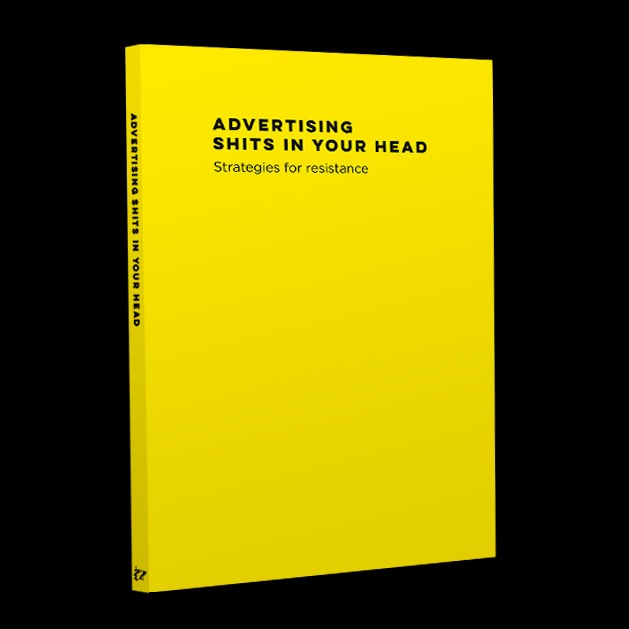
Advertising Shits In Your Head combines theory and practice in one short book about the modern subvertising movement. Featuring: Public Ad Campaign, Brandalism, Special Patrol Group and Dr. D.
Expected delivery: January 2017
Read a sample chapter: Advertising Shits in Your Head - Chapter 1
Advance praise for Advertising Shits In Your Head:
_
“Have you ever stopped to wonder why you know so much about things you are not interested in: brands, products, courses, colleges, holidays you might take, clothes you should wear? You may think yourself immune, but advertising is subliminal. You might ignore the Facebook posts that are ‘sponsored’, the animated billboards, and you may always skip the adverts as fast as you can. But to ignore them you first had to recognise them for what they were. And even in that small instance of time a logo has seeped into your subconscious. If advertising didn’t hit the target it would not be made. You are the target." – Danny Dorling (Author)
"Advertising Shits In Your Head provides a history of the practice (going back to the early 70s), alarming research and theory on the effects of the industry, advice about how to take part (including legal information) as well as several stunning case studies. This is essential reading for all who want to fight back against 'the most powerful and sustained system of propaganda in human history'.” – Jamie Kelsey-Fry (Contributing-Editor, New Internationalist)
"Advertising Shits In Your Head concisely describes, through unique first-hand accounts, the range of concerns adressed by today's subvertising community. From a right to the city argument, to the belief that advertising is the biggest obstacle to avoiding catastrophic climate change, Advertising Shits In Your Head envisions a movement looking far beyond culture jamming and corporate identity sabotage." – Jordan Seiler (Public Ad Campaign)
"Advertising Shits in Your Head gives form and context to culture jamming practices in the 21st Century. It is an important contribution on the path to realising the possibilities of creative practice as a vehicle for social change. Providing important theoretical and historical context that unites the twin strands of activism – creativity and resistance – it shows how creative minds are getting together in the age of digital networks to hack space and place, and challenge the presence of capitalist values within our public, private and cultural spaces. Advertisers most definitely shit in your head: this book is here to stop them." – Bill Posters (Brandalism)
"Advertising is a gigantic machine for creating human misery. It's a sustained psychological assault on the population and it is hard to overstate the brutal and permanent damage it does to us as individuals, to society, and to the planet itself. This book is a manual on how to begin the process of dismantling the machinery of advertising: how to interrupt it, sabotage it and one day, maybe, destroy it entirely." – Darren Cullen (Spelling Mistakes Cost Lives)
"Once advertising has shit in your head, you're going to need something to clean it up with; I couldn't recommend this book more highly." – Dr. D
One of the most important things we can do to address the egregious use of our public space to stoke the fires of consumerism, while undermining our individual and community well being, and monopolizing an important space for public discourse, through the proliferation of outdoor advertising imagery, is to talk about it, think about it, and write about it so that more people begin to understand the profound ways in which it is both a cause and a symptom of many of the problems our collectivity faces today. While I may have chosen another title for the book, Advertising Shits In Your Head, is an important addition to the small collection of literature around this very important public topic. And when it really comes down to it, the book title really is just the honest truth.
Please take the time to visit the crowdfunder campaign and donate even a small amount of money to help cover the printing costs of this non-for-profit publication and publisher.
"Advertising Shits In Your Head combines theory and practice in one short book about the modern subvertising movement. Featuring: Public Ad Campaign, Brandalism, Special Patrol Group and Dr. D. Dog Section Press is a not-for-profit publisher and all of our publications are printed with Calverts, a workers' co-operative."
Interested in watching the works of Sut Jhally? www.thoughtmaybe.com has put them online along with a bunch of other interesting films that any PublicAdCampaign reader should take the time to watch. A big thanks to Kyle Magee for turning us on to this fantastic resource.
Hackpacks and the right to the city: some thoughts
Some really interesting thoughts coming out of the UK on ad takeover work and its role in imagining new social realities not just on the street but in the larger cultural context.
It costs an advertiser a few £10k’s to access bus shelter advertising spaces, it costs you £6. After their involvement with Banksy’s Dismaland exhibition, Strike Magazine! have been working to ensure public access to a third of the global outdoor media landscape; offering inhabitants the tools to claim their right to at least a part of the city. Their hack pack comes with a handy how-to guide. More [HERE]
I finally had the chance to read Alison Young's Street Art, Public City: Law Crime and the Urban Imagination. Its a wonderfully researched investigation into the legal barriers broken by situational art in public space and how those transgression can envision an alternative city or way of being. For me it pins a lot of the same tactics discussed in Property Outlaws: How Squatters, Pirates, and Protesters Improve the Law of Ownership by Sonia Katyal, on street and graffiti writers, which I have always felt appropriate. For anyone interested in street art and its politics beyond the image, this book is a must read.
Upon speaking to a PhD Student in London, I also found my way to a very interesting paper by Anne M. Cronin entitled "Advertising and the metabolism of the city: urban space, commodity rhythms". This paper is the first I have come across that looks beyond a textual critique of advertising in outdoor space and instead looks at the ways in which it shapes the city and its inhabitants by co-opting the rhythms of public movement. I can't recommend this short paper enough to anyone who is interested in understanding how the very presence of commercial media in public space regardless of the specific messages, can cause a change in our social behavior and link us closer to the cycles of commodity consumption. Download [HERE]
A Conference Considers the Philosophy of Street Art
Hrag Vartanian just interviewed Nicholas Riggle about a conference at Pratt Institute finishing up this weekend with a keynote by Allison Young. I wont be able to make it, but I highly recommend making the effort to any readers who might be in New York. In the short interview, Riggle makes an amazing point that I think relates well to this blogs thesis, and my understanding of advertisings misalignment with our goals for cities and thier public spaces.
"The street is a cultural space, one of the essential functions of which is to promote public interaction by facilitating self-expression. That’s a function that a space can have more or less, and it’s one that a space can lose."
Thinking about what advertising does to our shared public environment in relation to this quote, it becomes pretty clear that a fully functioning public space cannot be one that includes commercial messaging.
Today, a three-day conference titled Philosophy of Street Art: Art in and of the Street begins at Pratt Institute and New York University. Organized by Gregg Horowitz of Pratt, Nicholas Riggle of Lafayette College, and Christy Mag Uidhir of the University of Houston, the event will feature an artist panel (with Leon Reid IV, HOTTEA, ELBOW-TOE, and Tatyana Fazlalizadeh), two days of papers and discussions, and a keynote lecture by a leading authority on the topic, Alison Young of the University of Melbourne, who will speak about “Mainstreaming the Street: The Cultural Value of Illicit Street Art." Read the full interview [HERE]
UC Berkely Class Talk and San Francisco/Oakland Bus Shelter Access
Me and the UC Berkeley students in front of a takeover in Oakland, CA. 2014
At the end of April I was in Oakland visiting a group of students at UC Berkeley California. The students were wrapping up a seminar class on the philosophy of street art taught by an old high school friend of mine, Seth Yalcin. I haven't spoke to Seth since high school and he found my work when he was forced to watch This Space Available on a leg of his flight home. The documentary was a larger investigation of outdoor advertising's role in public space and the various actors that fall on every side of the debate. I guess his interest was peaked and shortly thereafter he got in touch about putting together a syllabus.
Students seemed to come from a few different disciplines, including urban planning and development, which I was happy to see. We spoke for about an hour in class and then went out to the streets for a quick little action. I absolutely love teaching and working with students of all ages. The energy and enthusiasm, in most students, is infectious.
Market Street, San Francisco 2014
While I was in Oakland I made sure to get out in San Francisco to test some of the infrastructure there and see what was accessible. There are a plethora of bus shelter and free standing advertising frames littered throughout the city operated by Clear Channel. It didn't take long before two trips to the hardware store had fashioned the elusive 5 sided tamper proof bit that is required to open most of these structures.
Hand crafted tool for San Francisco Clear Channel advertising
Mission Street public restroom 2014
While in San Francisco, I noticed that JCDecaux operates the public restrooms sporadically strewn around Bart Station entrances. I carry all of my keys with me on my travels so I quickly replaced this advertisement to show that I could. Slowly an archive of keys is building which will be put online in the coming months as the PublicAccess project.
From Graffiti to Advertising: This 7 Train Ad Wrap Represents a Loss of Cultural Identity
Martha Cooper posted this image to her Instagram of a full outer car advertising wrap on the elevated 7 line. The fact that this train runs directly across from the infamous 5 Pointz is not lost on her as she was integral in capturing the birth of Graffiti many years ago, and likely shot similar images of the early greats decorating the outside of NY's subway transit system. The change in content makes me think of BC Biermann's academic paper entitled "The Battle of LA: Graffiti, the Self and the Reappropriation of Semiotic Space" The sad state of our corporatized cities and the loss of cultural identity that comes with it.
BriCollab Presents: Contrasting Enterprises: Outdoor Advertising and Public Spaces
A screening of the documentary, This Space Available, followed by a discussion.
Common in an urban setting, outdoor advertising dominate public spaces. Municipalities generate revenue from advertising agencies erecting large, high production value, mainstream messages. In confronting the nature and prominence of this industry and cultivation of cityscapes, there are complex issues of economics, urban development, public space, aesthetics, and availability of resources within a community to express them.
This Space Available is a documentary that confronts these issues. Inspired by Rio de Janeiro municipal decision to strip all the billboards from one of Brazil's largest cities, director Gwenaëlle Gobé, investigated worldwide, looking how billboard industry impacts various cities. She connected with powerful members of the advertising industry as well as guerrilla street artist groups in order to grapple with the question, who is the public space for and who can express there? She catalogs the efforts and statistics of the advertising industry while showcasing the oppositional efforts that seek to reduce the amount of outdoor advertising in cities. The conversation at The New School with faculty Andy Berhiemer (Parsons The New School for Design), Victoria Marshall (Parsons The New School for Design), and Shoshanah Goldberg Miller (The New School for Public Engagement) discuss the contrast between commercial and public spaces with the idea that it is possible to traverse encounters between people as mediated through architecture, design, and municipal policies.
Sponsored by the BriCollab project in the School of Media Studies.
Global Liberal Media Please - The Work of Kyle Magee
Image of ad takeover by Kyle Magee in Melbourne Australia
---------
It's funny, I have been working on the PublicAdCampaign project for over 10 years now. As both an artistic and activist endeavor it has had its ups and downs, fast paced movement, and lulls in activity. At times it seems worth giving up on and at other times the only way forward. When asked to summarize my goals I often respond,
"To better the health of our public spaces and by extension our collective society by questioning the role outdoor advertising plays in our shared visual public environment."
While removing the burden of commercial media on our public spaces might be a clear aim, the path taken to get there is not. Despite all of my activities, I have yet to see any significant change in how we treat our shared public spaces. I take heart in the small victories and know that my role is partially to bring attention to a question which unduly receives very little. I am a small part in a growing machine that one day will bring real and permanent change to our public spaces. Actively expressing my views is an important part of helping to create the society I want to live in.
That said the tactics one chooses to fight an injustice or bring an issue to light are not all created equal. Kid Zoom recently made me aware of one of the most well spoken (minus the constant expletives thrown into his writing) and courageous advocates for a democratic and open public media space that I have ever come upon. Kyle Anthony Magee from Australia does one thing, he gets arrested. His tactic is to buff over outdoor media as public protest which he believes is within his rights. In the process, Kyle leaves behind notes, manifestos, his phone number and name, and other information implicating him for his "crimes". He has posted his police interview in which he admits to his actions but demands he is not guilty. He is open and upfront about his views and believes that the fastest way to have them implemented is to put them before the law. He has gone so far as to continue his actions despite the courts telling him not to, bringing his actions to their very steps in defiance.
To the average individual and in particular his arresting officers, Magee must seem borderline mad, but to me he is convicted. I have never gone as far as Magee has to put myself in harms way, but I have openly taken responsibility for my actions with the understanding that there could be legal ramifications, and these would bear out a discussion of the issues. It would seem that Kyle's method eschews all of the cat and mouse in order to bring the issue to the relevant opinion makers as swiftly as possible. It is a bold tactic and one which I hope wins the hearts of his fellow Australians.
While his tactics may seem brash, they speak to the magnitude of his beliefs. His willingness to stand behind his actions, despite the harm which will come to him by doing so, should give everyone pause and cause them to look harder at his demands.
The questions Kyle poses about commercial media and its affects on global poverty, global environmental issues, and our individual and social psychological health are relevant questions to ask in a world which faces such immense hurdles to solve each of these growing problems. What if we banned commercial media in public space? What effects would that have on our individual health and behavior and how would those individual effects add up to a global effect on both our planet and our society as a whole? While you may not agree with Kyle's methods, you must agree that the questions he asks us to ask ourselves are extremely important as commercial media invades more and more of our daily lives. If the answers we come up with serve to promote commercial media than so be it, but we cannot be sure until we dare to look. Magee, in the most agressive of ways is asking us to look, and at a great cost to himself and im sure to those around him. I think we should all give him a bit of our time.
I just got back from NuART 2012 a few days ago and had an amazing time. First, my immense gratitude goes out to the dedicated team which put on such a rich and inspiring event. Those names include Martyn Reed, Marte Danielsen Jolbo, Irene Ostbo, Sesella Knutsvik, GT Aamdal, and Kristel Talv.
During my stay I was asked to do three things in no particular order of importance, create gallery work for the opening exhibition, do some sort of ad takeover in Stavanger, and give a talk for the NuART plus program.
I began by installing two light boxes which I had previously shipped over a few weeks before. These light boxes are where my gallery work is going these days and involve an advertising frame, a used book, some LED lighting and a lot of drawing with pencil charcoal and spray. Knowing the work would be in a long "tunnel", I opted for two images which had religious undertones, hoping to create an alter effect at the end. Sharing the room with Ben Eine, I was able to keep the room dark and produce the affect I was hoping for by accompanying the two pieces with a video at floor height of how I got the frames, so that viewers had to bend down in front of the two women. I was pleasantly with the way the light boxes appeared to float in space. I apologize for the photos as these pieces are incredibly hard to photograph.
photo by Ian Cox
On wednesday evening 9-26-12 I installed a large ad takeover project of my own work. This takeover targeted the downtown Stavanger city center and included 30 freestanding and bus shelter ads as well as 3 street level billboards. I concentrated the work as tightly as I could hoping the repetition would clue people in to the detournement. Sure enough Mobstr, one of the other artists involved, told me that driving through downtown the repetitive nature of the image made him realize just how much advertising is on our streets, even in a small town like Stavanger.
Sadly, with an article in the local paper appearing the next morning, all of the bus shelter and freestanding ads were removed by 9am thursday morning. Unmentioned in the news article, the billboards stayed up. I was pretty upset about the work being removed so quickly because I was hoping to point out the pieces to participants in a street art walking tour that RJ Rushmore and I did thursday afternoon. In my anger, that same evening I decided to turn all of the advertisements that replaced my work upside down as a way of showing my unhappiness to JC Decaux. This little gem, plus my mention on facebook that I would be staying for another week or two to continue my work, prompted a call from JC Decaux. Basically they were calling to see if I would continue to make work for them and would they have to continue to remove my work or turn back around the advertising that replaced it. What I find interesting, and typical, is that they did not call the police despite being very aware of who was responsible for the civil disobedience. Unable to confront my transgressions for what they are, or maybe just unwilling, the typical industry response is to lay low. Open public discussion of the issue is the last thing they want as this discussion might actually lead to their demise. Maybe I just need to make them more mad!
The last part of my participation was in NuART Plus which was a first at this years event. The Plus program attempted to tackle some of the issues raised by street art and urban interventionist tactics, while talking directly to the community instead of amongst ourselves. My participation included a talk called Interrogating Utopia: Conscientious Curation of our Shared Public Spaces. All in all I felt it was well received and I will post the video of my talk as soon as it is available. I was pleasantly surprised with the turnout at the Plus event which included city planners, council members, community activists and others from the community that might not engage street art as part of properly functioning cities.
You can see more of my street work from NuART 2012 [HERE]
A new study shows that billboards negatively affect the values of neighboring properties. It also found that cities with strict billboard controls are experiencing greater economic prosperity than those with controls that are less strict.
The report, “Beyond Aesthetics: How Billboards Affect Economic Prosperity,” by urban planner Jonathan Snyder, is believed to be the first study on the economic impacts of billboards on nearby real estate value. Click here to download the study (PDF).
Objective Measures of Emotion Related to Brand Attitude: A New Way to Quantify Emotion-Related Aspects Relevant to Marketing
While using quantifiable science to test subjects likes and dislikes toward a product seems relatively benign and even potentially beneficial, to use these methods to create better brand associations and marketing techniques borders on brainwashing. While I know these scientific endeavors wont stop, having control over their influence on me is my only line of defense as a citizen in a consumer world trying to retain core values not expressed in consumer marketing techniques. Omitting these messages and new techniques from public space allows us to retain a public identity outside of commercial influences.
Abstract: With this study we wanted to test the hypothesis that individual like and dislike as occurring in relation to brand attitude can be objectively assessed. First, individuals rated common brands with respect to subjective preference. Then, they volunteered in an experiment during which their most liked and disliked brand names were visually presented while three different objective measures were taken. Participant's eye blinks as responses to acoustic startle probes were registered with electromyography (EMG) (i) and their skin conductance (ii) and their heart rate (iii) were recorded. We found significantly reduced eye blink amplitudes related to liked brand names compared to disliked brand names. This finding suggests that visual perception of liked brand names elicits higher degrees of pleasantness, more positive emotion and approach-oriented motivation than visual perception of disliked brand names. Also, skin conductance and heart rate were both reduced in case of liked versus disliked brand names. We conclude that all our physiological measures highlight emotion-related differences depending on the like and dislike toward individual brands. We suggest that objective measures should be used more frequently to quantify emotion-related aspects of brand attitude. In particular, there might be potential interest to introduce startle reflex modulation to measure emotion-related impact during product development, product design and various further fields relevant to marketing. Our findings are discussed in relation to the idea that self reported measures are most often cognitively polluted.
This Space Available - DOC NYC World Premier at the IFC Theater
PublicAdCampaign is proud to announce the world premier of the documentary film This Space Available. This full length feature focuses on the issue of visual pollution in our global community. Intent on creating a critical dialogue on the issue, the film investigates a wide range of perspectives including those of billboard executives, government agencies, and public space activists like myself. While the film will eventually be widely available, DOC NYC will be premiering the film on Saturday November 5th at 7pm at the IFC theater in New York City. There will also be a Q&A after the screening for viewers to question the film makers and a few of the subjects. We hope to see you there.
To purchase tickets for the This Space Available premier at the DOC NYC fest at the IFC theater on 11-05-11, please visit the DOC NYC website [HERE]. Remember there is limited space available so get your tickets now before they are all gone.
Billboards and commercial messages dominate the public space like never before. But is a movement taking shape to reverse this trend?
In This Space Available, filmmaker Gwenaëlle Gobé says yes. Influenced by the writing of her father, Marc Gobé (Emotional Branding), this new director brings energy and urgency to stories of people around the world fighting to reclaim their public spaces from visual pollution.
From 240 hours of film, 160 interviews and visits to 11 countries on five continents, This Space Available charts a fascinating variety of struggles against unchecked advertising and suggests that more than aesthetics is at stake. If Jacques Attali once called noise pollution an act of violence, is visual pollution also such an act? Should we also consider, as one Mumbai resident says, “which classes of society can write their messages on the city and which classes of society are marginalized?”
Gobé offers a canny generational analysis of visual pollution, laying blame not just with the advertising juggernaut but also an entire generation of Baby Boomers, whose consumption-based culture has implicated them in the environmental fallout. She argues that it’s her generation, left to do the cleaning up, that is now leading the fight back.
But the filmmaker also recognizes the history and politics behind this fight. Turning to such legislation as the Highway Beautification Act of 1965, Gobé shows how the enforcement of this landmark law, designed to regulate outdoor advertising on America’s roadways, has steadily eroded. And today, public space activist Jordan Seiler faces harsh penalties for covering illegal outdoor ads with art, while officials turn a blind eye to illegally erected billboards.
Still, the film strikes a hopeful tone. A standout interview features Gilberto Kassab, the popular mayor of Sao Paulo, who threw a stone into the quiet pond of the billboard industry by successfully banning outdoor media in his city – the eighth largest in the world. The move is not without precedent: Houston’s 1980 billboard ban was also a deliberate tactic to improve its flagging image, economic competitiveness, and quality of life.
In the end, This Space Available challenges audiences to recognize that aesthetics and beauty go hand in hand with responsibility. Gobé asks why brands continue to ally themselves with an industry that cuts down trees, hogs energy, and spends its profits in courts and statehouse lobbies, especially while younger consumers push for improved corporate citizenship? And is everyone equally to blame for enabling the spread of visual pollution, while other humble individuals show that it’s possible to reverse it?
The film navigates these issues without promoting a universal solution. Gobé instead weaves together stories reflecting diverse local responses to an increasingly global condition. This Space Available compels audiences to consider these stories long after the film ends, or at least to remember them each time we speed by a billboard.
Augmented Reality and the Reappropriation of Public Space
The AR AD Takeover project came out of a discussion between myself and BC Bierman. A paper has finalized that discussion and created an academic framework around which the project can be understood. Please take a look at it if the abstract below is of interest.
Abstract:
This project employs augmented reality (AR) technology to layer urban centers with artistic content in the virtual world. Specifically, the Takeover is an AR deployment that uses street level phone booth ads and billboards to trigger a citywide curated art installation that displays on Android and Iphone mobile devices. This project showcases street artists whose work has historically addressed commercial advertising in public space. This project examines how civic authorities allow certain private parties to profit while preventing or discouraging other forms of public media production. It is with a certain sense of ironic playfulness that we utilize technology to create a kind of hypAR-reality, which implodes the distinction between the physical and the digital, to make evident the consumptive hyper-reality created by commercial advertising. We hope to problematize the top-down hierarchy of the traditional advertising model and pave the way for a more democratic, relativistic model that opens up a meaningful discourse between commercial advertisers and the public. This project is premised on the idea that capitalism - simply by pursuing its natural operational processes - possesses inherent problems of defining the ideal citizen and creating incentives for the exchange of valuable ideas. Conceived in response to this flaw in the system, we designed the AR | AD Takeover as preliminary step in the evolution of the messaging in public space from being predominantly commercial to a more democratic, open environment.
Matthew Tedford spoke with me about public space and artistic activism for his masters thesis a while back. his insight into the projects goals and expectations is pretty spot on and if ever anyone wanted an academic framing of the NYSAT project, this video is a wonderful aid.
without spoiling the content of the video I will pull out this one quote which is an argument against a typical response to the SAT projects that bemoans the "quality" of the artworks produced under police surveillance and impending arrest.
"politics springs forth from a pluralism of members within a given community. if a space of freedom and action exists debate and contestation between these members produces politics. such a precept implies that the context and the display of an artwork is as important to its political efficacy as its formal characteristics."
Urban Geography With the Royal Holloway University of London
I have been doing a bit of talking these days, most recently at the Southern Graphics Council in Saint Louis and today with Geography students from the Royal Holloway University of London. We had planned a long walk from City Hall to the Lower East side, but rain and cold winds caused us to retreat back to my studio. Normally I use this walk to talk about the different affects of the visual environment on spatial control and environmental issues but today, in the studio, the conversation focused more on PublicAdCamapaign actions and other street art/urban art projects. As per usual, the most important teaching tool I have found is action, and the phonebooth install above was done to show the students how simple public space interaction can be.
Radical Rutgers Professor Maps Toxic Ads, Then Buys Billboards to Publish Her Results
I just stumbled upon Naa Oyo A. Kwate's pursuits through GOOD magazine. She is currently working on projects which map and catalog outdoor advertising content and relate those statistics back to social health issues which might be a result of said advertising. Her results are astounding and yet another reason for the public to take seriously the role that outdoor advertising plays in our public and thus private lives. On top of this she plans to purchase outdoor advertising space for her own messages which speak to the problems she has come across. While I love this idea, I would be incredibly surprised if she was allowed to purchase ad space to critique outdoor advertising. I will be doing more research on Naa as I am sure there is much more to discover. While were at it, Ron English knew tobacco, McDonalds, and liquor ads were bad way back when. He didn't map them, he just re-imagined them.
Naa Oyo A. Kwate's innovative research analyzes the urban environment in terms of its impact on health. As Associate Professor in the Department of Human Ecology at Rutgers University, she carries out studies that focus on what she calls "toxic exposures" to things like fast-food outlets, advertising messages, and even subtler cues such as bulletproof glass, barbed wire, or shopfront security grilles. [More]