This blog is a resource for ad takeover artists and information about contemporary advertising issues in public space. If you have content you would like to share, please send us an email.
Eduardo Moises Penalver & Sonia Kaytal Property Outlaws: How Squatters, Pirates, and Protesters Improve the Law of Ownership
Barbara Ehrenreich Dancing in the Streets: A History of Collective Joy
Lewis Hyde The Gift, Creativity and the Artist in the Modern World
Geoffrey Miller Spent: Sex, Evolution, & Consumer Behavior
Wednesday, April 22, 2020
Why Open Public Space is Central to a Vibrant, Democratic Society and How the Corona Virus Threatens to Divide Us
Why Open Public Space is Central to a Vibrant, Democratic Society and
How the Corona Virus Threatens to Divide Us
I just did an interview with public radio in Boston about the public space implications of the ongoing Covid 19 pandemic. The reporter was interested in what we will do without our “third spaces,” the places that we frequent every day and that give structure to our lives. I don’t know about you, but we still drive to our coffee place and now instead of sitting down and having breakfast, take out our coffee and sit at the beach to drink it.
Public space offers the daily glue by which we come into contact with diverse and different people who make up our social world. There is 30 years of ethnographic research evidence that public space is a major contributor to a flourishing society through promoting social justice and democratic practices, informal work and social capital, play and recreation, cultural continuity and social cohesion, as well as health and well-being.
But during this 'virus' moment we are all experiencing a shrinking sense of the world and focusing more on our own families, neighborhoods, cities and states as we translate the numbers of Covid 19 patients and increasing numbers of deaths into the risks that we are facing individually. This isolation tears the fabric of our lives and exposes how dependent we are on one another for our well-being and happiness and how interconnected our networks are in our local communities.
Most of my older friends are suffering from isolation and loneliness because they can’t go to their neighborhood gym to workout, meet in their local bar to talk at the end of the day or attend classes at their church or synagogue. The number of calls I make to my family and friends has increased and I treasure my online courses and meetings with students.
I expect that those ties will remain intact regardless of how long this persists as we are actively “missing them” in a palpable and visible way.
However, what I am more concerned about (and I heard myself say to the interviewer) is the impact on the use of public spaces that are now deemed dangerous because of the possibility of coming into contact with those who might be infected. Similar to people who live in a gated community, each time we walk outside we are reminded by the media not only to wash our hands but to exercise social distancing and avoidance. While this is certainly prudent advice, we need to ask what the long-term impact will be on the fragile ties that weave a complex society together.
Just the daily separation of us and them (or “people like us” and “others”) becomes a pattern that is expanded into increased segregation and with it less tolerance, more fear and greater prejudice. What then might be the consequence of fearing that others may be contagious and unknowingly cause us harm? I expect that social distancing could be a new norm, recruited for other purposes and feed into already festering class and racial anxiety, now in a “medicalized” form. And what about the xenophobia of calling it a “Chinese virus” and recent attacks on
“Chinese” people simply because our President has associated a nation with the initial infection. Where does this kind of thinking and daily practice lead? A “booster shot” to the already increasing xenophobic, racist hate crimes that predated the viral threat?
All this is to say that not only is our physical, mental and economic health being challenged, but also our social health that depends on ongoing interaction with people who are different in a multiplicity of ways. Psychologists have demonstrated that such contact has a liberalizing effect and increases creativity.
I think in these difficult days that it is more important than ever to think about the various challenges that we face, and to not retreat into separate “clean” places for some and “dirty” ones for others. Instead I suggest that we consider the bases of resilient communities and the lessons we can learn from them.
Resilient communities are flourishing, connected, and based on a human and non-human ecological network that is adaptable, flexible and responsive. This useful conceptualization draws upon ideas drawn from positive psychology, contact theory and human ecology. Positive psychology studies the strengths and attributes that enable individuals and communities to thrive. Seligman and Csikszentmikhalyi provide evidence that flourishing is comprised of encouraging positive emotions, engagement through activities, relationships with other people, meaning and purpose, and accomplishments. Contact theory demonstrates how face-to-face interaction promotes social cohesion while ecological multispecies models emphasize the importance of networks for the health of interconnected ecosystems.
To these psychological and biological considerations, my research adds social justice as a critical additional component, which at the individual level is sense of fairness, but at the community and societal level is composed of social inclusion and belonging, cultural representation, recognition of difference, and an ethic of caring.
Public space is the major site of social interaction, contact and connection in our society. Failing to appreciate its importance and its promise as we practice social distancing and relocate our social lives to a virtual realm, also puts us at risk. I suggest that we remember and continue to celebrate what we are temporarily losing so that when we can come together again, we appreciate its power to improve our lives.
Setha R. Low is a Distinguished Professor of Environmental Psychology, Geography, Anthropology, and Women’s Studies at The Graduate Center, City University of New York. She is also director of the Public Space Research Group. Dr. Low is the author of 15books, including Spaces of Security and Behind the Gates: Life, Security and the Pursuit of Happiness in Fortress America (Routledge, 2003, first edition ). She is currently writing the forthcoming Why Public Space Matters, which isunder contract with Oxford University Press.
My colleague Bill Posters wrote an incredibly important essay outlining the main points of interest for the anti advertising, pro civic media movement. Please read it!
His writing shows us that while the out of home advertising industry acted as the fuel for neoliberal capitalism and helped sustain the post war growth of American consumerism, we have entered a new epoch that makes the incantations of billboards and bus shelters look quaint in comparison. Dataism and the rise of behavioral data collection, because of its accuracy and pervasiveness, threatens more than the sanctity of our shared public public spaces, but will likely influence fundamental aspects of our collective social behavior in ways that will drastically alter society as we evolve into the future. It's fucking scary. What happens when the data exhaust you produce is so granular that Spotify can accurately predict when you are in a bad mood? And what then when Spotify realizes that your consumption drops in those moments of aggression and actively makes decisions to prevent that behavior from diminishing your capacity as a consumer? Now extend that type of influence over all networks and all devices and you see a human being pushed and pulled in ways that it cannot see, and cannot control, all to increase ones predictability as consumer, and you start to see how over a few hundred years the nature of society is fundamentally changed as people become more and more tuned by the needs of those in control of the data we collectively produce. Like a meteor on a collision course with earth, you don't change a society by blowing it up, you send out a small satellite to slowly push the course of its direction over many years and watch as the final destination finds itself far of course. In one case we all sign in relief, in the other we loose our free will to the corporate entities that control the data of our lives.
Nada, played by Roddy Piper, picks up a pair of black-rimmed glasses and puts them on, but these are no ordinary glasses, these glasses are X-Ray specs. Immediately they détourne all forms of corporate propaganda that he casts his gaze at—the billboard advertisements, magazines, and television programmes all change. All are subverted to reveal an alternative truth (in essence), making the invisible visible, revealing in the process the hidden infrastructures, architectures and power relationships that exist between corporate and state level actors—in the case of They Live aliens, and their subjects—citizens of the US. Everyone is asleep, Nada is awake.
More [HERE]
Below is a wonderful essay by RJ Rushmore for Monument Lab. Im not sure how much RJ is aware of the writing of Jeff Ferrell but his sentiments echo a lot of Jeff's criminological research. Pigeon holed by the anti advertising title, most anti advertising activists are actually trying to imagine what might replace the commercial images that surround us if given the chance. RJ is well aware of this and like a lot of us, trying to figure out how to recontextualize what he is doing so that it broadens his demands and has more potential to change not only our streets, but fundamental ways in which we interact and exist with one another. Fantastic.
Skateboarders refuse to see the city as intended. It is a playground. It is theirs. Every curb, bench, and set of stairs is a potential skateable object. Even though I put down my own skateboard around age 15, that mindset stayed with me. Skateboarding gave me a gift: the inclination to resist the pressures that cities feed us to be passive. As I've spent the last decade alongside artists who intervene in public spaces (be that through street art, graffiti, public art, or street performance), that inclination has matured, evolved, and became the driving force behind my work as a writer and curator. More [HERE]
Matthieu Lietaert sent me this link to his most recent documentary on advertising persuasion in the modern age. Please take an hour to watch and support this much needed critical thinking.
Have you ever wanted to discover the behind the scenes of marketing persuasion? To know what technologies and scientific methods are used to unveil your consumer black box? ADS IN WONDERLAND gives the floor to those who create advertising: CEOs of advertising agencies, neurosciences experts, industrial psychologists, and data engineers. It also let whistleblowers and activists highlight the dangers of this revolution for our planet and for democracy. After ADS IN WONDERLAND, you won’t see your daily ads the same way you used to do… Watch Movie [HERE]
One of my ongoing personal projects these past few years has been the Collisions series. These photos document simple graphic BW patterns illegally installed into outdoor advertising around the world. On the street, the patterns are intended to grab a viewers attention with an image that has little reference to advertising and is hard to interpret as anything other than an interruption. I am interested in viewers thinking about the act of disobedience, the space around the advertisement, the frame that holds it. I want to create a small amount of room for radical imaginaries to blossom and allow utopian visions to tumble out of simple disruptions of reality.
"In elaborating and image of the future, utopian thought also generates a viewpoint from which the present becomes open to critique."
I choose the Collisions locations very carefully to create strong, well balanced photographs of the city. I want viewers of the photographs to be able to come back to the imagery over and over again. I want them to be meditative and an opportunity for believers to renew thier belief.
For those that only see the documentation, the images can be anemic. Proof of the politics that took place on the street isnt immediately recognizable. But hidden within the image itself is a digital video of the street installation viewable through an augmented reality mobile app. In this way the photographs take thier creative politics with them wherever they go, and for me remain charged objects.
Last year I decided to take the first 15 images from the Collisions series and put them in a small Zine/Booklet. It is a beautiful little signed edition of 400. Three essays by Jeff Ferrell, Thomas Dekeyser, and Carlo McCormick give the imagery unique context and insight. Thier thoughts give credence to the idea that our role as individuals is to push on the margins and expand our collective understanding of the world around us.
Artist Nikolas Bentel is on a mission to destroy an original Robert Rauschenberg in a project intended to emphasize how the art market is, in his words, “a glorified stock market.” Beginning this week, the artist — who is part of the New Museum-led incubator New Inc. — is selling off sections of the artwork as advertising space, so its surface will eventually be covered with an eclectic assortment of images.
More [HERE]
The Crisis of Attention Theft—Ads That Steal Your Time for Nothing in Return
Tim Wu, author of The Attention Merchants has written a compelling article for Wired magazine essentially accusing much of todays public advertising industry of theft. Right on Wu!
By now, it is pretty well understood that we regularly pay for things in ways other than using money. Sometimes we pay still with cash. But we also pay for things with data, and more often, with our time and attention. We effectively hand over access to our minds in exchange for something “free,” like email, Facebook, or football games on TV. As opposed to “paying” attention, we actually “spend attention,” agreeing to the view ads in exchange for something we really want.
Read more [HERE]
I wrote the following Hyperallergic article about the recent Subvertisers International week of action. The text was inspired by Luna Park's amazing photos of the NYC portion of the international event. Luna is the only photographer I know going out of her way to point her camera at the subvertising/ad-takeover movement. I cannot thank her enough for her continued interest in the political nature of the work and our sincere attempts to bring this small but significant issue to the forefront of our collective consciousness. I think she, like many other public/street/graffiti artists, see the value in having a public space that feels rich with voices and is worth diving into headlong with your eyes wide open.
Since this article is short, it talks a big game while leaving a lot to be said another time. One day I will try to write a long form essay that delves deeper into the many issues surrounding this work, its history, intention, and efficacy. Until then please enjoy this attempt to quickly put some perspective in place.
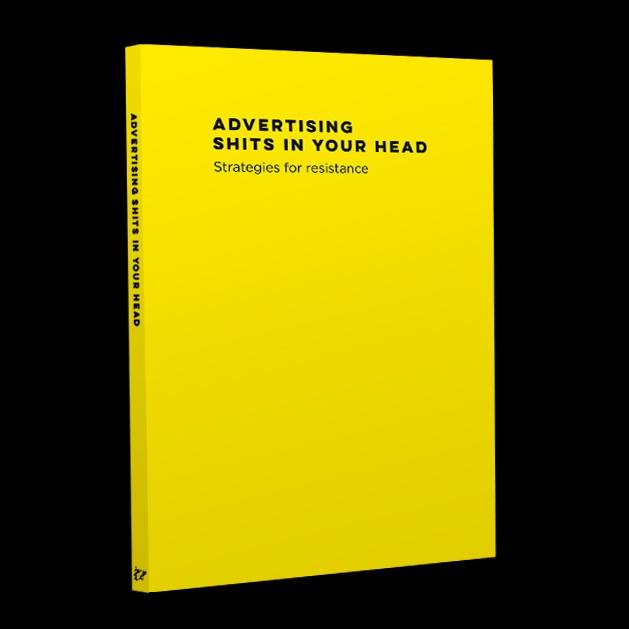
Advertising Shits In Your Head (no author is given), is a pocket-sized book, but it’ll burn a hole in any pocket you put it in. It’s a powerful tirade against advertising and what it does to our minds, to our culture, to our planet. But not content to sit and fulminate about it, it is a book that’s about action, about actively reclaiming our mental environment. As Banksy puts it: More [HERE]
Wonderful little article on a new publication that I am super proud to be a part of called "Advertising Shits in Your Head" get a copy [HERE] It is only 4$
Vyvian Raoul brings us three exclusive interviews with the subvertising artists featured in a new book on the contemporary subvertising movement, Advertising Shits In Your Head. More [HERE]
The last time I was in London I was posting some small works on the street over some pretty nice Fly Posting locations. Halfway through I noticed an older gentleman taking notice and then filming me after he asked if "I was supposed to be doing, what I was doing." I finished my work while he called the cops. I took a few final photographs and then before packing up decided to engage him as he was still idling around the area. This interaction turned out to be one of the more bizarre and interesting street moments I have had yet. Turns out the person I was talking to was at one time a Fly Poster himself, operating illegally to cover the streets in commercial posters, and also a professor who had thought plenty about the streets of his city and what kinds of policy, be it formal or informal, makes for a vibrant and engaging public environment.
We exchanged information and the man who would have had me arrested has become a bit of a friend as we email back and forth and try to get to the heart of the matter. The heart of the matter to me is that today this man operates Flying Leaps, a company that makes "art" posters which are illegally placed on the street next to illegal advertising and which can be bought online. To me they are simple advertising that hides behind a more altruistic vision, but advertising nonetheless. To him they are an attempt to use public space in the participatory manner that all Fly Posters agree to, and which street artists and graffiti artists prescribe.
Take a look at his essay on the topic below as it is well worth the read and makes an interesting point that is often overlooked and that I did not expect to be made by an advertiser them self. The streets are becoming less and less accessible, even to the advertisers that once used them, as multinationals control more of our lives, including what we see on our way to work.
In this age of immateriality, as mobile phone apps and e-mail blasts add new marketing potentials undreamed of in the […] [19th century], it may seem curious to look at posters as a distinct form. But posters’ format provides a snapshot of broader epochal transition. To be sure, posters are no longer the darlings of most modern advertisers, but they have hardly died away. Indeed, how and when they are deployed becomes all the more interesting. When Apple iPod was launched, the company chose a poster campaign, presenting silhouettes of listeners dancing against backgrounds of screaming, saturated colour, to convey the physicality and sensory depth of the iPod experience. Even – perhaps especially – in a digital age, the materiality and life of a poster can maintain a powerful hold on us.
Advertising Shits In Your Head combines theory and practice in one short book about the modern subvertising movement. Featuring: Public Ad Campaign, Brandalism, Special Patrol Group and Dr. D.
Expected delivery: January 2017
Read a sample chapter: Advertising Shits in Your Head - Chapter 1
Advance praise for Advertising Shits In Your Head:
_
“Have you ever stopped to wonder why you know so much about things you are not interested in: brands, products, courses, colleges, holidays you might take, clothes you should wear? You may think yourself immune, but advertising is subliminal. You might ignore the Facebook posts that are ‘sponsored’, the animated billboards, and you may always skip the adverts as fast as you can. But to ignore them you first had to recognise them for what they were. And even in that small instance of time a logo has seeped into your subconscious. If advertising didn’t hit the target it would not be made. You are the target." – Danny Dorling (Author)
"Advertising Shits In Your Head provides a history of the practice (going back to the early 70s), alarming research and theory on the effects of the industry, advice about how to take part (including legal information) as well as several stunning case studies. This is essential reading for all who want to fight back against 'the most powerful and sustained system of propaganda in human history'.” – Jamie Kelsey-Fry (Contributing-Editor, New Internationalist)
"Advertising Shits In Your Head concisely describes, through unique first-hand accounts, the range of concerns adressed by today's subvertising community. From a right to the city argument, to the belief that advertising is the biggest obstacle to avoiding catastrophic climate change, Advertising Shits In Your Head envisions a movement looking far beyond culture jamming and corporate identity sabotage." – Jordan Seiler (Public Ad Campaign)
"Advertising Shits in Your Head gives form and context to culture jamming practices in the 21st Century. It is an important contribution on the path to realising the possibilities of creative practice as a vehicle for social change. Providing important theoretical and historical context that unites the twin strands of activism – creativity and resistance – it shows how creative minds are getting together in the age of digital networks to hack space and place, and challenge the presence of capitalist values within our public, private and cultural spaces. Advertisers most definitely shit in your head: this book is here to stop them." – Bill Posters (Brandalism)
"Advertising is a gigantic machine for creating human misery. It's a sustained psychological assault on the population and it is hard to overstate the brutal and permanent damage it does to us as individuals, to society, and to the planet itself. This book is a manual on how to begin the process of dismantling the machinery of advertising: how to interrupt it, sabotage it and one day, maybe, destroy it entirely." – Darren Cullen (Spelling Mistakes Cost Lives)
"Once advertising has shit in your head, you're going to need something to clean it up with; I couldn't recommend this book more highly." – Dr. D
Simple, effective and always on point. As funny as this piece is for a chuckle and a nod, this is pretty serious on a fundamental level. When we privilege one type of communication over another we are making a collective decision about our priorities and ultimately our desires for our future selves. As of right now, we got it all fucked up and Mobstr knows it.
One of the most important things we can do to address the egregious use of our public space to stoke the fires of consumerism, while undermining our individual and community well being, and monopolizing an important space for public discourse, through the proliferation of outdoor advertising imagery, is to talk about it, think about it, and write about it so that more people begin to understand the profound ways in which it is both a cause and a symptom of many of the problems our collectivity faces today. While I may have chosen another title for the book, Advertising Shits In Your Head, is an important addition to the small collection of literature around this very important public topic. And when it really comes down to it, the book title really is just the honest truth.
Please take the time to visit the crowdfunder campaign and donate even a small amount of money to help cover the printing costs of this non-for-profit publication and publisher.
"Advertising Shits In Your Head combines theory and practice in one short book about the modern subvertising movement. Featuring: Public Ad Campaign, Brandalism, Special Patrol Group and Dr. D. Dog Section Press is a not-for-profit publisher and all of our publications are printed with Calverts, a workers' co-operative."
Advertising on Public Buildings Is a Sad, Terrible Thing
This little rant by Jared Brey is one of the most succinct and compelling arguments against outdoor advertising, particularly on municipal infrastructure, that I have ever read. The quote below is so good I had to put it directly into this post but read the rest of the article for more interesting observations about why advertising on municipal buildings is a terrible fucking idea!
Two, this proposal will supposedly generate “up to $500,000” a year, which is a glass-half-full way of saying it will generate less than $500,000 a year. Half a million dollars is no pittance, of course, and in a poor city like Philadelphia, every penny helps. But $500,000 is just 0.0125 percent of the $4 billion municipal budget. For comparison’s sake, that same portion of the $41,233 median income in Philadelphia is just five dollars and 15 cents. If someone asked you to hang a billboard on your front door and promised you “up to” $5.15 a year in return, what would you say? I know what I’d say: Get right the fuck out of here, please, sir. Read more [HERE]
take the words off advertising campaigns and what do they really say?
The premise of this project makes sense but in reality I don't think I get from these images what Hank Willis Thomas thinks I will get. That said they are disturbing in thier own way.
In his exhibition 'Unbranded: A Century of White Women, 1915 – 2015,' Hank Willis Thomas strips text from ad campaigns to show how our ideals are really marketed to us. More [HERE]
A Brief Look At Why I Remove And Replace Outdoor Advertising
People often ask me why I do ad-takeovers and promote similar civil disobedience amongst my peers. The simple answer is that I believe ingesting too much commercial media (advertising) makes it harder for us to be mindful conscientious citizens, and anything we can do to make our personal and collective behavior better is a step in the right direction to achieving a more just and equitable world. This belief is supported by scientific research into advertising’s psychological impact on the individual, along with the resulting behavioral challenges it creates for us socially, but which is beyond the scope of this essay.
Buried right below the surface of that “why” question is another, and that is what task is accomplished by your ad-takeover work? What wrong is being righted by removing or replacing outdoor ads? And ultimately, will or could ad-takeover work ever result in real social change? I believe the answer is yes, which is why I continue use it as the main focus of my artistic project.
Advertising aggression and the desired city:
Advertising is the promotion and dissemination of messages whose primary interest is to convince you to align yourself with the advertisers agenda. Often this is the purchase of a product or service, which gives the entire affair a somewhat nefarious atmosphere as the practitioners work to persuade you to their ends.
For this reason most of us are skeptical of advertising and its goals, particularly those of us who see the economic and environmental issues that our society faces, in large part due to the rampant consumerism fueled by advertising itself. Many of us also deride advertising for the social and psychological impact it has on us by preying on our insecurities or appealing to our own self-interest. Even when advertising is at its best and masquerades its activities as a gentle nudge, we see its intention with the clarity offered by the inescapable truth that it is out to change our minds.
Because of this, we all seem to intuit that the form itself is to be avoided and when asked about a more conscientious media environment, that the individual advertising tactics are irrelevant. More often than not we seek to avoid the pressure placed on us by advertising.
And yet an increasing number of our cities are offering more and more space to these messages. Today, this situation seems inevitable because so many of us have grown up in cities surrounded by commercial media, and to question it seems like a fanciful dalliance towards a dead end. We sit by and watch as billboards and placards have given way to a vast infrastructure on which outdoor advertising resides including our buses(inside and outside)-bus stops-subways-subway stations-subway platforms-subway entrances-subway fare cards-taxi cabs(inside and outside)-pedicabs-trolleys-airports-freestanding placards-building facades-sidewalks-construction hoardings-wall wraps-pop up marketing events, etc. etc. Even the skies are written on in the summer months in New York.
The deep saturation of our public environments with commercial media is written into the language and strategies employed by the industry itself, offering “station domination” campaigns to compete in already heavily media saturated environments. The fact of the matter is that navigating public space in our cities involves interacting with large amounts of commercial advertising.
As a lifelong city resident, this obvious schism between individual desire and how cities are currently practiced is difficult to swallow. It seems to defy the idealistic utopian logic of cities that I fondly invoke when I dare to dream of cities at their best; the one in which our collective will sets the groundwork upon which our cities forms and function are determined. Even my practical understanding of cities doesn’t seem to jive with the idea that what we seek to avoid, would be thrust upon us.
The obvious reason for this discrepancy between the desired city and the actual city is that there is a lot of money being made on advertising content, and more importantly on the spaces that it occupies. Like so many aspects of our lives, the public environment itself has been monetized, and it would appear against our better judgment. As unfair as that might seem, this impropriety pales in comparison to the fact that the money being made through the sale of our shared public resource is done so by selling you and your attention to companies intent on capturing it.
Your eyes are worth money and unwittingly you have become a product being bought and sold between commercial media companies and the businesses that they sell your public environment to. When looked at so plainly it doesn’t make sense to me that there would be advertising in public space at all for the simple reason that it uses a personal resource, to do something against our collective will, in order to benefit someone else.
The false justification for outdoor advertising:
The prevailing logic behind advertising (and why we allow our cities formal arrangement to defy common sense) is that it pays for something we want in return for the nuisance of being distracted for someone else’s purpose. Public space adheres to this same logic and we are asked to believe that advertising is an integral part of maintaining our cities infrastructure.
While advertising revenue is significant, the idea that advertising is a necessary evil we must endure in order to keep our trains running falls apart under closer scrutiny. Immense profits are extracted from our cities by out of home media giants like JCDecaux that defy the assumption advertising is anything more than a way to turn the city into a profitable venture. If advertising were truly intent on nourishing underfunded public good, we would see to it that all of the profits were invested back into our city, and this is simply not the case.
Instead, the city is auctioned off and deals are made on our behalf to share portions of the revenue made from the attention we didn’t want to put on offer in the first place. So comfortable have we become with this inequitable deal that we have given up on the simple expectation of reciprocation from advertising, fully conceding that advertisings presence is just a part of modern life.
Illegal advertising, ephemeral marketing, brand engagement events, and a spectacular array of advertising techniques that fly under the radar of public policies attempting to capture small portions of public advertising revenue, run rampant in our cities. The premise that advertising should be endured because it provides a public service is simply false.
An informed critical response:
So I go out and remove ads without thought to the legality of my actions, but with an understanding of their justness when perceived from a practical perspective. I do so because like so many other forms of civil disobedience aimed at private property, it calls attention to an aspect of society that I think warrants closer inspection, but which is difficult to approach through more traditional channels of democracy.
Given my concerns about the effects of advertising on our ability to fully live as mindful conscientious citizens, which is borne out in social and psychological research, addressing the issue in a way that will result in advertisings removal, is my top priority. I have chosen to do so through civil disobedience, but there are more traditional methods available that I have forsaken and a brief explanation of why is important to answer if we want to get to the heart of what good comes of ad-takeover work.
Like many cities, New York controls the proliferation of outdoor advertising by permitting both the companies that operate outdoor advertising businesses, as well as the individual signs when applicable. This allows cities to keep some semblance of control over public space, while demanding revenue in the form of contractual agreements and yearly fees.
In 2009 I became aware that the NYC Department of Buildings had put its records online in an easily searchable database. This allowed me to look up the legality of many of the signs that looked down on our streets and to eventually realize that a company called NPA City Outdoor was operating hundreds of locations without permits, and therefore illegally. I began the painstaking process of calling the DOB Sign Enforcement Unit, tasked with policing outdoor advertising offenses, to report the illegal signage as I came upon it.
This exhaustive and lengthy process began to turn the slow wheels of justice and I watched as violations and fines were levied against each offending location. The problem was that none of the signs came down and it became clear to me that the city itself was not prepared to take on the legal might of a business with the deep pockets afforded by advertising revenue. Legal channels alone were simply not enough to combat this problem.
I then organized a large-scale civil disobedience project called NYSAT that would illegally, but very publicly, condemn the company by bringing out hundreds of citizens to whitewash all of their billboards and replace the imagery with public artworks. It was hoped that through media attention and a little bit of embarrassment, we could grease the wheels of justice and set in motion a series of events that would eventually lead to the actual removal of the illegal signs and the company operating them.
This is exactly what happened and I watched with excitement as NPA City Outdoor began a five-year battle with New York that they would eventually lose. Addressing legal advertising with these same tactics would be harder, but it seemed that prompted by a little civilian led direct action, the legal structures we had in place could actually reign in advertising and begin to remove advertising from public space entirely.
I don’t believe I could have been more wrong. Within a year of NPA loosing their court battles and removing most of their signs from the streets of NYC, their advertising tactics were tweaked and they began operating in the city once again. It was at this point that I came to realize that the profits for advertising were too great to maintain any real enforcement of the publics will. In fact, cities themselves were helpless despite strict rules and regulations; only a full change in public opinion towards advertising in public space would result in the changes I wanted to see.
So I returned to my tactics of removing advertising from public space without permission and attempting to promote similar civil disobedience amongst my peers. I did so less because I thought that this was the road to full removal of advertising from public space, than because it was all I had left.
Though it would appear disheartening, I quickly realized that my goal when doing ad-takeover work should not be to remove the ads themselves but to question the medium more generally. What we are doing when we do ad-takeover work is not righting any wrong, but using the medium itself to question its perceived authority in the hopes that those watching will think more deeply about the schism between what they want and what they see in front of their eyes.
In fact, to say this is accomplished through individual advertising takeovers is a little bit of self deception as most advertising takeovers go unnoticed. What we are truly trying to accomplish when we do advertising takeovers is change public opinion, and that task is done through personification and our lived experience. Like most civil disobedience against private property, my continued disregard for outdoor advertising in general and the rules that govern right and wrong in relation to it, allows me to be a focal point upon which the issue can be discussed more deeply.
Through discussion comes understanding, and through understanding comes belief, and what I believe is that cities can be better.
Thomas Dekeyser wrote a nice blog post on Robert Montgomery's work that I think does a good job of navigating his desire for subvertising work to always be illegal in order to retain the most powerful critique of capitalism and the systems that help to perpetuate it. Montgomery's work isnt always illegal and yet it is incredibly powerful so parsing these two thing out isn't easy when you want to see the world in black and white. Well worth a read as Dekeyser is becoming one of my favorite thinkers on this topic.
Last week I went to hear Robert Montgomery speak at The Art Conference. I’ve been reaching out to him for a while now, trying to arrange a conversation, without luck, so I was excited to finally hear one of my favourite subvertising practitioners elaborate on his practice and related politics. More [HERE]
Interested in watching the works of Sut Jhally? www.thoughtmaybe.com has put them online along with a bunch of other interesting films that any PublicAdCampaign reader should take the time to watch. A big thanks to Kyle Magee for turning us on to this fantastic resource.
The enforcement of city and state law pertaining to graffiti, advertising, and other signage has enormous power to visually shape public space. In New York City, enforcement is heavily skewed to ignore illegal commercial advertising, while simultaneously aggressively targeting graffiti and, in some cases, symbols of dissent. More [HERE]