


New Public Spaces Are Supposed to Be for All. The Reality Is More Complicated.
VIA: NY Times

Labels: New York, news articles, NY times, public/private
Other Activists ProjectsRECOMMENDED READINGAdvertising and the metabolism of the city: urban space, commodity rhythms Street Art, Public City: Law Crime and the Urban Imagination The Spectacle of Accumulation Essays in Culture, Media, & Politics The Codes of Advertising Tom Crompton Guy Shrubsole Think Of Me As Evil Property Outlaws: How Squatters, Pirates, and Protesters Improve the Law of Ownership Dancing in the Streets: A History of Collective Joy The Gift, Creativity and the Artist in the Modern World Spent: Sex, Evolution, & Consumer Behavior |
|
Wednesday, November 14, 2018New Public Spaces Are Supposed to Be for All. The Reality Is More Complicated.
VIA: NY Times
Labels: New York, news articles, NY times, public/private Tuesday, September 26, 2017How Parks Lose Their Playfulness - And I am baaaack!
I am going to start posting to this site again. It is an effort to keep up with consistent content, even if I am mostly reposting articles, but its worth it. I feel a little naked without it and truthfully, it was Instagram that sapped most of my creative energy away from this little endeavor. Lets see what happens.
VIA; The NY Times  Labels: news articles, NY times, Parks, public/private Tuesday, May 30, 2017Billboard-sized portraits of ordinary people have Providence residents talking.
I cannot say how much I love and believe in this project. It only happens that the artist teaches at my Alma Mater and the project is happening in Providence Rhode Island.
VIA: Upworthy
 He wasn't a fashion model or trying to sell anything. He was a mechanic shop owner from Guatemala living in Providence, Rhode Island, and this was all very new to him. It's not every day you see yourself on the side of a building looking out over a busy downtown.More [HERE] Labels: billboards, legal, public art, public/private Wednesday, May 17, 2017Where's the Boundary Between Public Art and Advertising?
VIA: City Lab
 Labels: news articles, NYC, public advertising, public art, public/private Sunday, April 23, 2017The Crisis of Attention Theft—Ads That Steal Your Time for Nothing in Return
Tim Wu, author of The Attention Merchants has written a compelling article for Wired magazine essentially accusing much of todays public advertising industry of theft. Right on Wu!
VIA: Wired
 Labels: criticism, illegal advertising, legal, news articles, public advertising, public/private Thursday, April 20, 2017A ‘Members Only’ Public Space in Manhattan? Join the Club
Not about advertising in public space but about the concept more generally.
VIA: The New York Times
 Labels: New York, NY times, public/private Friday, February 17, 2017Public Space in the Trump Era
Not exactly about advertising but to the larger point of our shared environments no longer be shared.
VIA: Architect Magazine  Labels: police, public/private Thursday, December 8, 2016NOTES ON FLYPOSTING AND POROUS URBAN SPACE
The last time I was in London I was posting some small works on the street over some pretty nice Fly Posting locations. Halfway through I noticed an older gentleman taking notice and then filming me after he asked if "I was supposed to be doing, what I was doing." I finished my work while he called the cops. I took a few final photographs and then before packing up decided to engage him as he was still idling around the area. This interaction turned out to be one of the more bizarre and interesting street moments I have had yet. Turns out the person I was talking to was at one time a Fly Poster himself, operating illegally to cover the streets in commercial posters, and also a professor who had thought plenty about the streets of his city and what kinds of policy, be it formal or informal, makes for a vibrant and engaging public environment.
We exchanged information and the man who would have had me arrested has become a bit of a friend as we email back and forth and try to get to the heart of the matter. The heart of the matter to me is that today this man operates Flying Leaps, a company that makes "art" posters which are illegally placed on the street next to illegal advertising and which can be bought online. To me they are simple advertising that hides behind a more altruistic vision, but advertising nonetheless. To him they are an attempt to use public space in the participatory manner that all Fly Posters agree to, and which street artists and graffiti artists prescribe. Take a look at his essay on the topic below as it is well worth the read and makes an interesting point that is often overlooked and that I did not expect to be made by an advertiser them self. The streets are becoming less and less accessible, even to the advertisers that once used them, as multinationals control more of our lives, including what we see on our way to work. VIA: Flying Leaps  In this age of immateriality, as mobile phone apps and e-mail blasts add new marketing potentials undreamed of in the […] [19th century], it may seem curious to look at posters as a distinct form. But posters’ format provides a snapshot of broader epochal transition. To be sure, posters are no longer the darlings of most modern advertisers, but they have hardly died away. Indeed, how and when they are deployed becomes all the more interesting. When Apple iPod was launched, the company chose a poster campaign, presenting silhouettes of listeners dancing against backgrounds of screaming, saturated colour, to convey the physicality and sensory depth of the iPod experience. Even – perhaps especially – in a digital age, the materiality and life of a poster can maintain a powerful hold on us.More [HERE] Labels: criticism, flyposting, illegal advertising, London, public advertising, public/private Friday, March 25, 2016NYCLU Demands Tighter Privacy Protections For City's Public Wifi
I have some pretty serious reservations about the LinkNYC system that outpace my love of free WiFi and cell phone charging. They arent new concerns but ones brought into astral focus once you realize what type of data 7500 well placed tracking devices can produce in NYC. As 2d static advertising goes the way of the dinosaur and digital begins to take its place, data protection will become almost as important as trying to remain outside of advertisings influence as it will allow more insidious advertising to worm further inside the brains of even the most adamantly anti advertising of us all.
VIA: Gothamist
 Labels: Link NYC, news articles, NYC, public advertising, public/private, Titan Media Thursday, February 18, 2016Barcelona Is Targeting Billboards It Sees as 'Pollution'
While some might think I am crazy, or just a little to "passionate", about how our public spaces are used by the OOH industry, I give you the below article. I feel like the recent rise in legitimate questioning of advertisings assumed right to our public environment by local governments and individuals, is giving credence to my craziness. Beyond being harmful to our collective psyche, are we simply giving it all away too cheaply? Why subject ourselves to the whims of an industry hellbent on using our attention to create vast wealth that they then extract away from our cities, leaving them crowded with imagery that no one wants to see, and devoid of the individual character that makes each beautiful concrete jungle its own. Barcelona mayor Colau doesn't see the problem in black and white but he sure does understand that Barcelona is getting the short end of the stick.
"Across the board, Barcelona Mayor Ada Colau’s administration has been fighting to cut back on what it sees as commercial exploitation of the city."  Labels: Barcelona, city government, news articles, public/private, spain Friday, August 14, 2015Can cities kick ads? Inside the global movement to ban urban billboards
My friend Dennis over at Ban Billboard Blight sent me this article from the Guardian. Many of the issues that I find most interesting about advertising and public space are addressed in the article, if only briefly. It is after all a short news story. I was particularly happy with fact that the author addresses the tone of the OOH industry towards thier occupation of our public environment, and what that means about thier overall goals and appreciation for the public to which they subject thier business.
And then there is the mention of a Zadie Smith essay in the NY Review of Books, which all of my smart friends failed to alert me of. I guess all of thier constant pressure to subscribe was not only well intended, but also a good idea.
VIA: The Guardian
 Labels: news articles, NO AD, public advertising, public art, public/private, Sao Paolo Friday, July 10, 2015In Bushwick, Street Art Comes with a Copious Side of Advertising Billboards
Everyone asked for comment in this article, including myself have something interesting to say. On a compete side note, I wish writers would let you know that they may quote entire sections of your emails verbatim. I always assume they will integrate your ideas into a story and so often whatever grammatically deficient gibberish i spew out in an email on the plane home from Germany ends up as a quote. :)
VIA: Hyperallerigic
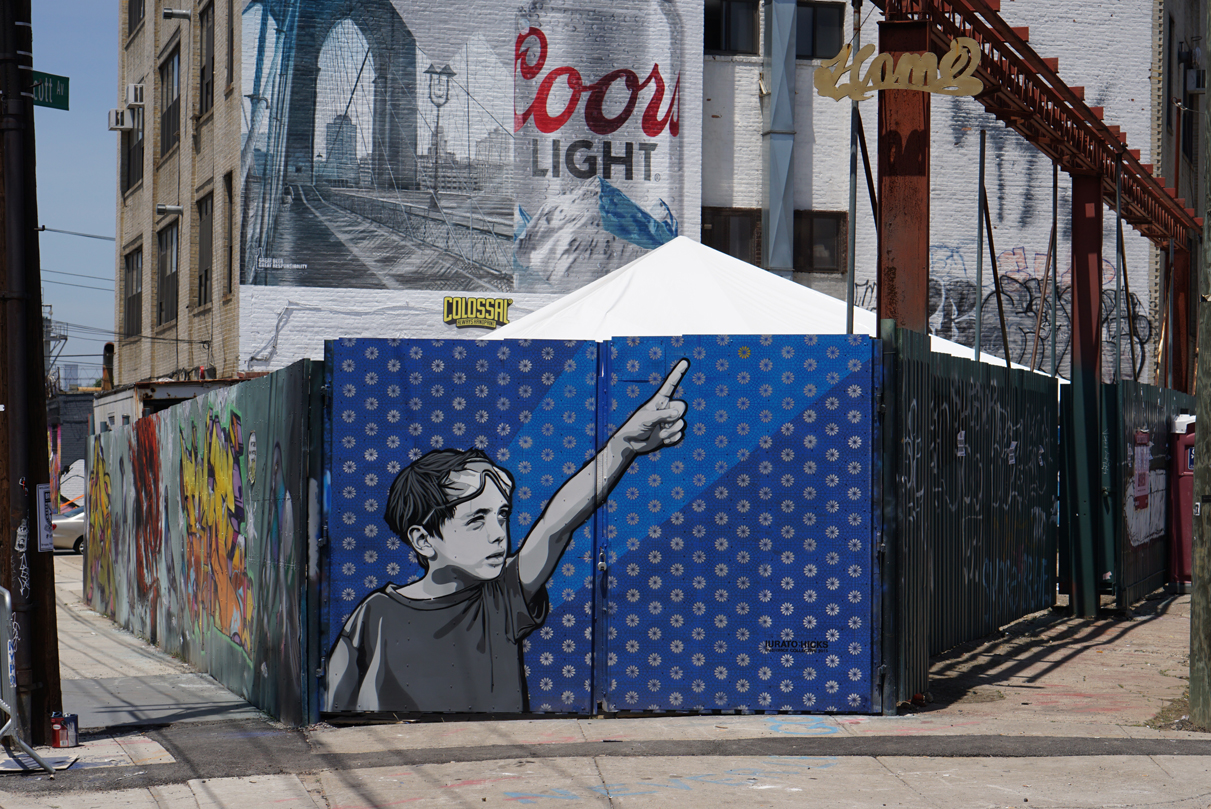 The latest additions to the Bushwick Collective, the street art project founded and curated by Joe Ficalora around the intersection of Troutman Street and St Nicholas Avenue in Brooklyn, are a number of big, garish billboards. Since artists began transforming warehouse walls in the area with large-scale murals three years ago, there has been remarkably little infringement by the type of advertisements and hand-painted billboards that have overtaken many popular street art spots in Williamsburg and Greenpoint. But in recent weeks, as Bushwick Daily has pointed out, advertisements have begun appearing on the Bushwick Collective blocks, some of them installed directly atop existing murals. More [HERE] Labels: ad creep, Brooklyn, HyperAllergic, New Advertising, public advertising, public murals, public/private, street art Friday, July 3, 2015The Street Art of Bushwick Collective Is Disappearing Under Billboards
This is incredibly sad article is further proof that outdoor advertising is simply incompatible with public space. I know Anya of the House of Yes through friends, and she is a nice woman who has been seduced by the money that advertising is willing to pay for outdoor space. Her folding under the pressure of money is not her fault, but our collective fault for allowing advertising to use its incredibly large resources to sway normal citizens to profit at the expense of the rest of us. If advertising was not allowed in our public spaces we would continue to enjoy Bushwick as the arts mecca that it is, instead of watch the artists efforts be subsumed under a glut of paid commercial signage.
VIA: Bushwick Daily
 Labels: ad creep, public advertising, public/private, street art Saturday, May 9, 2015Baltimore's LED Art Billboard Is Nice, Sort Of
Don't be fooled, they use this billboard for advertising too, it just gets art sometimes as well. Hey it's a step in the right direction...
 Labels: billboards, digital, public/private Monday, March 30, 2015I Call It Progress  Labels: Contest Promotions, graffiti, New York, NPA outdoor, NYSAT, public/private Sunday, March 8, 2015The Cost of Paying Attention
I have always said, if not slightly in jest, that advertisers should pay for the space they take up in my mind. More specifically outdoor advertisers, as thier messages are forced into my brain without my consent and therefor occupy a special subsection of crap that fills my thoughts. If I hum a pudding jingle that I saw on TV, it is my own fault for letting that message creep into my mind in exchange for a little sitcom induced brain shutdown. If I cant seem to get the image of a 4 story overly sexed Justin Bieber out of my mind, I have only Calvin Klien and Outfront Media to blame for that intrusion.
It is with that thought that I post this NY Times article by Mathew B. Crawford. His argument, which is stated eloquently but isnt particularly new, is that we should treat our visual landscape like any other resource. We protect our air and water for the common good and the visual landscape that we share in public should be treated similarly so that the rampant abuse of that space does not cause negative economic or health issues for the population at large. I couldn't agree more. Mathew focuses his attention on an airport, which provides some nice examples of how our visual landscape is a worthwhile resource by juxtaposing the general airport with the paid lounges. If the wealthy are willing to pay for silence, or a lack of intrusion into thier visual landscape, it must have some worth.
Airports though, are both public and private spaces and while I couldnt agree more that they should be treated similarly to our shared city streets when it comes to visual pollution, actual public space has a more profound reason to remain commercial free. When we allow advertising to purchase the facades of our buildings, occupy our urban infrastructure, and generally access any and all of our shared environment, we lose something more than the valuable resource of silence. What we loose is access to our city and our literal ability to shape the environment we live in by visual interaction and cultural production.
If we allow advertising and commercial messaging to monetize the surface of our city, we loose access to those surfaces and with that our ability to define the cultural landscape in which we exist. To me this might be the most tragic loss due to public advertising but it surely isnt the only loss. Demanding an ad free public space is our right as citizens and of paramount importance as we continually define the objectives of our cities and the society that we want them to create.
VIA: The NY Times
 Labels: cities, NY times, public advertising, public/private, random thoughts Monday, January 19, 2015Without Advertising, the Walls Are Ours Again. This is just one of many examples and I will try to remember to snap more photos on my travels about the city. Labels: Art, Contest Promotions, graffiti, New York, NPA outdoor, NYC, Other Artists, public advertising, public art, public murals, public/private Saturday, November 29, 2014Grenoble, première grande ville européenne à bannir la publicité de ses rues
Looks like the city of Grenoble has made the decision to remove all outdoor advertising from it's streets. While it seems like there is a healthy debate happening online about the benefits behind such a move, "the city’s deputy mayor Lucile Lheureux explained: “The business model of street advertising is down. Advertisers want to upgrade to digital screens. We don’t want to make that move. We don’t want our city’s children bombarded with animated advertising on TV screens in the street.”
Although there will only be 326 ads removed in total, (not including the bus shelters which will stay until at least 2019 when the contract is up for renewal) for a city of this size making the bold move to improve the health of its citizens and streets, is a welcome reminder that all is not lost in the fight to improve out shared public spaces. In fact it's got more than a few industry insiders talking seriously about the backlash against brand intrusion.
VIA: Le Dauphine
 Labels: activism, France, JCDecaux, public advertising, public/private Friday, October 10, 2014NYC now has hundreds of ad beacons in phone booths (update: mayor orders them removed)
I've been seeing strange things happening to NY phonebooths over the past year or so. Suddenly a booth would appear, wrapped in a piece of sheet metal with a large sticker ad adhered to the entire three sided surface. It was strange because the installation covered what were three regular and working advertising boxes, for seemingly no reason. Well that reason has been revealed to be the installation of a Gimbal beacon capable of communicating with your smart phone and collecting passive data used to build a user profile. I'm glad to finally know why these strange phonebooths have started appearing and sad to know its part of a larger push to make advertising more effective, and invasive.
VIA: Engadget
 Labels: ad creep, New York, NYC, phone booth, public/private, Titan Media Thursday, October 2, 2014Madrid's Public Transit, Brought to You by Megacorporations
VIA: The Atlantic City Lab

For rent: one subway system. That seems to be the approach of Madrid Metro, which is taking public transit advertising to unprecedented levels. Until the end of October, users of Madrid Metro’s map app (downloaded 1.2 million times so far) will find their plan peppered with the logo of a supermarket chain. Thanks to a deal with French retail giant Carrefour—continental Europe’s answer to Walmart—logos of the megachain will appear wherever there’s one near a Metro station. The idea is to channel passengers in need of groceries straight off of trains and into nearby markets. There are over 100 stores on the map, making Madrid’s Metro map app look like it’s broken out with a serious case of Carrefour acne. More [HERE]
Labels: ad creep, advertising, Madrid, public advertising, public/private, spain |
|
Organized Civil DisobedienceArchivesRECOMMENDED READINGThe Cultures of Cities Branding New York No Logo Culture Jam Captains of Consciousness All Consuming Images Channels of Desire Crimes of Style Tearing Down the Streets Ways of Seeing Taking the Train Evictions art + spatial politics Death+Life of American Cities |
