|
|
|
The Black Plague: Coronavirus Takes Over Israel's Billboards
Just a Quarter of New York’s Wi-Fi Kiosks Are Up. Guess Where.
Hate Those Floating Digital Billboards? New York Just Banned Them
Depending on your point of view, they are either miracles of modern marketing or a heinous eyesore on the city’s waterways.Either way, the digital billboards that had been plying the East and Hudson Rivers over the last several months may soon be a thing of the past, as Gov. Andrew M. Cuomo signed legislation on Monday to ban them. More [ HERE] Labels: illegal advertising, New York, public advertising
Sante Publique - Participatory Civic Media and the Pursuit of a Collective Will
Santé Publique_Film from Clément Fessy on Vimeo.
Lately I have been thinking about the term Participatory Civic Media and what that would look like in practice. For years my work was a reaction to the misuse of our shared public space by advertising. Taking matters into my own hands I practiced a righteous form of civil disobedience in which I allowed myself to trespass on the private property rights of outdoor media companies in order to air my grievances in the court of public opinion. I still very much agree with this type of direct action tactic and feel comfortable advocating for a more lenient understanding of public visual space usage and rights. The PublicAccess project is a good example of my thoughts on the matter. In stark contrast to the broken windows theory, I believe a little anarchy on the streets is a far better scenario than the pristine walls of an over policed well controlled city.
While I would love to convince everyone to participate in the curation of thier shared environment without care for the consequences, I must admit that most people don't see the value in breaking the law to put up pictures on the street, and many people aren't compelled to do so even if it were legal. And yet I truly believe that placing something you have made onto our shared city streets is a worthwhile exercise that can change your relationship to your city. Suddenly you realize that the imagery that surrounds us is part of an attentional economy created by the accumulation of our bodies and eyeballs. Your part in creating this economy gives you rights to it usage that can suddenly feel trampled upon when you realize that advertising has commandeered the majority of our shared public environment, and we have criminalized most non transactional appropriations. Outrage might not be the right word but questioning who gets to use our shared public spaces and who benefits from its usage is the natural progression of ideas after using public space for your own thoughts and desires.
It is therefore incumbent on me to think beyond the civil disobedience projects whose righteous indignation is a good measure of my concern but less useful as a tool for mass persuasion. How can I convince citizens to participate in the curation of thier shared public spaces so that they can reap the benefits of that participation and come to realize their rights as citizens to dictate how thier cities look? The answer seems to be working in more formal ways which set aside the unsavory aspects of how I believe public space should be used in favor of participation above all else.
Last year I bit my tongue and dived head first into the Sante Publique project. After being invited to Sainte Etienne to paste on the Le Mur wall, I was told by the curators that the city had in addition offered me 75 Lollipop advertising pillars. These freestanding advertising venues were operated by a an outdoor advertising company that handled the cities public advertising on bus shelters, trams, and lollipops. As part of their contract with Sainte Etienne, 75 spaces were reserved for broadcasting of cultural events and related messaging and represented the altruism that masked the malevolence which is blanketing a city in advertising to turn a profit for private corporation. By agreeing to use these spaces I would be accepting the current version of public space usage in which private companies controlled the infrastructure on which messages were broadcast, profiting from it greatly, and returning a small bit of that space as an act of kindness to be lauded.
If I had my way we would kick the for profit advertising companies off our streets, treat the attentional economy we all create like the collective resource that it is, and use our shared public spaces to fund a vast network of participatory civic media structures meant to advocate the views of each cities unique citizenry. Baby steps. If that was the goal, I still needed to convince the public that they wanted to participate in the civic media environment. So I agreed and let go of the fact that the Sante Publique project would leave intact the system I was ultimately trying to remove. Instead I concentrated on reaching people who were unlikely to think about our shared public visual environment. bakers, teachers, scientists, singers, poets, secretaries, garbage men, and everyone in between. Instead of using the spaces for my own artwork, I would offer the spaces to these unsuspecting citizens.
The result was a city in which for 1 week 75 unique voices graced the streets and a new way of looking at the public visual environment in Sainte Etienne was established. Participants gained an appetite for seeing thier own thoughts reflected on thier city streets and those who saw thier work were offered an alternative vision in which public space was used by individuals instead of advertising and institutionally sanctioned messages. When the project was over people weren't exactly questioning if the advertising company who sanctioned our project should exist, but they were wondering why their access to public space was limited to a one off art experience. Many people asked if we would repeat the project again next year, and if it would grow to include more participants. I couldn't answer that question for sure but if Sainte Etienne was progressive enough to continue down this path, the eventual result after sustained growth would be a city with little time for the advertising on its streets and a vested interest in the Participatory Civic Media network they had slowly developed over the years.
Huge thanks to Marlene Mendes for collaborating with me on this project and to Ella an Pitr for their initial and continued support. Thanks to Clement Fessy for creating the beautiful documentation. Thanks to Raphael Jonjour and the city of Sainte Etienne for being so progressive and to all of the friends and family that helped make this happen. Last thank you to the 75 participants that took the time to contribute to this project and steward their public spaces.
Labels: advertising, France, public advertising, public art, video
On Crowded London Streets, Councils Fight a Flood of Phone Boxes
Zaha Hadid Architects transforms the classic billboard into public art
‘Reclaiming public space’: How Philadelphians turned ads into art
I am continually baffled by the fact that we clearly want more public art but we still let corporations set the price for access to use our very own shared public spaces.
Almost two months ago, the ads came.
“300 jeeps cheap!” the words in bright yellow lettering blared from nearly 400 Big Belly trash cans around Center City. It’s followed by a 1-800 number for an auto dealership.
Immediately, Philadelphians took notice. Journalist Stephanie Farr tweeted that the ads looked terrible, journalist Jim MacMillan called them hideous. The words “eye sore” were thrown around on Twitter, and within days one can lay in a melted pile on the ground (though it’s unclear whether that was linked to outrage over the ads).
More [ HERE] Labels: Philadelphia, public advertising, public art
‘New York’ magazine covers become public art in citywide installation
The line between art and commerce on our streets has become so blurred that a New York magazine "Wildposting" campaign can be pitched as a public art program. Wildposting is illegal advertising, or graffiti by another name. When someone wild posts on your property, the image below shows what you have to do in order to avoid fines from the city. I'm not saying I want NY magazine to stop, but I am saying that we need to reevaluate what constitutes proper use of public space and who gets access and who does not.
VIA: Curbed NYC
In honor of New York Magazine’s 50th anniversary, the publication is launching a year-long exhibit showcasing specially-designed New York covers by 50 renowned artists, called simply “A Public Art Project.” More [ HERE] Labels: New York, New York Magazine, public advertising, public art, Wildposting
Where's the Boundary Between Public Art and Advertising?
The Fearless Girl and Charging Bull statues have been facing off in Manhattan’s financial district since March 8. The optics are still startling: a girl, fists on her hips, ponytail swaying, stares down a 7,100-pound bull, which stands 11 feet tall and 16 feet long in the heart of one of the world’s most powerful economic centers. More [ HERE] Labels: news articles, NYC, public advertising, public art, public/private
The Crisis of Attention Theft—Ads That Steal Your Time for Nothing in Return
Tim Wu, author of The Attention Merchants has written a compelling article for Wired magazine essentially accusing much of todays public advertising industry of theft. Right on Wu!
By now, it is pretty well understood that we regularly pay for things in ways other than using money. Sometimes we pay still with cash. But we also pay for things with data, and more often, with our time and attention. We effectively hand over access to our minds in exchange for something “free,” like email, Facebook, or football games on TV. As opposed to “paying” attention, we actually “spend attention,” agreeing to the view ads in exchange for something we really want.
Read more [ HERE] Labels: criticism, illegal advertising, legal, news articles, public advertising, public/private
The Sculpture of a “Fearless Girl” on Wall Street Is Fake Corporate Feminism
I was gonna write something about this little tragedy but the wonderful Jillian Steinhauer beat me to the punch.
VIA: Hyperallergic
The bronze statue installed by an advertising firm and a financial firm represents basically everything that’s wrong with our society. More [ HERE] Labels: New Advertising, Other Artists, public advertising
Aiming to Disrupt Ads in New York City, Artworks Instead Blend In
My criticism of this project was announced by my questioning of the curators at a recent panel at the New School in NYC. Basically I was concerned that this type of project, while attempting to disrupt the ad cycle that so clearly has a strangle hold on our collective attention in public space, only further institutionalizes the infrastructure through which we receive this bombardment into the fabric of our city. What is passed off as critique is actually a deeply disturbing acceptance of our inability to imagine alternative visions of society through art. As if a colorful non-commercial image thrown into an onslaught of commercial media could somehow challenge the medium itself and help us to breath new life into a system that is normalizing consumptive behaviors that are at the heart of social and environmental issues we all face.
The idea behind Commercial Break — an exhibition produced by Public Art Fund (PAF) of 23 artists’ versions of visual “interruptions within the advertising cycles” on some of New York City’s most public screens — seems like a good one. The artist list is appealingly international, including Cory Arcangel, Korakrit Arunanondchai, Martine Syms, Hayal Pozanti, Cécile B. Evans, Tabor Robak, and Mary Reid Kelley. The project looks to inject an aesthetic time-out into the onslaught of commercial images meant to sell us new and improved versions of ourselves. It’s important that the work is being shown in public, because certainly more than languages, professions, or nationalities, New Yorkers share a familiarity with the discourse of advertising. It is merciless in its attempt to convince viewers of their own lack and of their need to buy their way out of the hole. More [ HERE] Labels: advertising, digital, digital advertising, Link NYC, New York, public advertising, public art
NOTES ON FLYPOSTING AND POROUS URBAN SPACE
The last time I was in London I was posting some small works on the street over some pretty nice Fly Posting locations. Halfway through I noticed an older gentleman taking notice and then filming me after he asked if "I was supposed to be doing, what I was doing." I finished my work while he called the cops. I took a few final photographs and then before packing up decided to engage him as he was still idling around the area. This interaction turned out to be one of the more bizarre and interesting street moments I have had yet. Turns out the person I was talking to was at one time a Fly Poster himself, operating illegally to cover the streets in commercial posters, and also a professor who had thought plenty about the streets of his city and what kinds of policy, be it formal or informal, makes for a vibrant and engaging public environment.
We exchanged information and the man who would have had me arrested has become a bit of a friend as we email back and forth and try to get to the heart of the matter. The heart of the matter to me is that today this man operates Flying Leaps, a company that makes "art" posters which are illegally placed on the street next to illegal advertising and which can be bought online. To me they are simple advertising that hides behind a more altruistic vision, but advertising nonetheless. To him they are an attempt to use public space in the participatory manner that all Fly Posters agree to, and which street artists and graffiti artists prescribe.
Take a look at his essay on the topic below as it is well worth the read and makes an interesting point that is often overlooked and that I did not expect to be made by an advertiser them self. The streets are becoming less and less accessible, even to the advertisers that once used them, as multinationals control more of our lives, including what we see on our way to work.
VIA: Flying Leaps
In this age of immateriality, as mobile phone apps and e-mail blasts add new marketing potentials undreamed of in the […] [19th century], it may seem curious to look at posters as a distinct form. But posters’ format provides a snapshot of broader epochal transition. To be sure, posters are no longer the darlings of most modern advertisers, but they have hardly died away. Indeed, how and when they are deployed becomes all the more interesting. When Apple iPod was launched, the company chose a poster campaign, presenting silhouettes of listeners dancing against backgrounds of screaming, saturated colour, to convey the physicality and sensory depth of the iPod experience. Even – perhaps especially – in a digital age, the materiality and life of a poster can maintain a powerful hold on us.
More [ HERE] Labels: criticism, flyposting, illegal advertising, London, public advertising, public/private
Giant E Ink Screens Turn Trucks Into Dynamic Rolling Billboards
The giant E Ink displays, developed by Mercedes-Benz, Visonect, and RoadAds Interactive, are actually each made up of four 32-inch E Ink screens that are synced to function as a single three-by-five-feet display with a resolution of 1440 x 2560 pixels and 16-levels of grayscale. More [ HERE] Labels: ad creep, advertising, europe, public advertising
Long Live Jean Claude Decaeux - An Obituary
I'm sure he was a really nice guy but christ all mighty he built an empire of...well shitty street furniture covered in ads in 3,700 cities worldwide.
Jean-Claude Decaux, who has died aged 78, was a French entrepreneur who made a fortune from outdoor advertising – on poster sites, bus shelters, kiosks, transport systems and even public lavatories. More [ Here] Labels: advertising, France, JCDecaux, news articles, public advertising
NYCLU Demands Tighter Privacy Protections For City's Public Wifi
I have some pretty serious reservations about the LinkNYC system that outpace my love of free WiFi and cell phone charging. They arent new concerns but ones brought into astral focus once you realize what type of data 7500 well placed tracking devices can produce in NYC. As 2d static advertising goes the way of the dinosaur and digital begins to take its place, data protection will become almost as important as trying to remain outside of advertisings influence as it will allow more insidious advertising to worm further inside the brains of even the most adamantly anti advertising of us all.
VIA: Gothamist
Civil libertarians are pushing the city to make its new public wifi kiosk network less data-mine-y, saying that the way the LinkNYC public wifi system is set up now allows for the creation of a database of all users' web activity that the NYPD could easily tap into if it felt like it. More [ HERE] Labels: Link NYC, news articles, NYC, public advertising, public/private, Titan Media
See That Billboard? It May See You, Too
Sellers of advertising space love to know who will be looking thier ad spaces so that they can allow companies to target more and more specific audiences. Online, this type of aggregate tracking is easy, but OOH advertisers have been hard pressed to create hyper accurate demographic studies linked to particular public spaces. Until now, anything more than a guess required someone onsite to tally information like gender, age, race, and whatever other important insight can be gleaned from ones appearance. It seems Clear Channel has solved this problem by getting cell phone companies, and nefarious mobile app producers whose apps gather geo location content, to allow them to link thier advertising sites to very specific consumer profiles and patterns of movement around the city. Want to target 20-30 year old males who shop at Abercrombie & Fitch... No problem. They are found concentrated on the 405 between 830am and 10am as evidenced by hard data reported through AT&T. Looking for 35-45 year old single mothers of 2 or more children? They are highly likely to be visiting super markets and shopping centers between 630pm and 8pm Monday through Friday.
The collusion between advertisers and corporations here is scary in that they are taking one step closer to be being in total and complete synchronicity. Each product, now finding the space in our city where it is most likely to be received by its intended audience and thus purchased. In the process, our conception of our consumer identity will be reinforced making its grip that much harder to resist.
Pass a billboard while driving in the next few months, and there is a good chance the company that owns it will know you were there and what you did afterward. More [ HERE] Labels: ad creep, news articles, NY times, public advertising, technology
Street Art, The Law, Advertising, The City
I finally had the chance to read Alison Young's Street Art, Public City: Law Crime and the Urban Imagination. Its a wonderfully researched investigation into the legal barriers broken by situational art in public space and how those transgression can envision an alternative city or way of being. For me it pins a lot of the same tactics discussed in Property Outlaws: How Squatters, Pirates, and Protesters Improve the Law of Ownership by Sonia Katyal, on street and graffiti writers, which I have always felt appropriate. For anyone interested in street art and its politics beyond the image, this book is a must read.
Upon speaking to a PhD Student in London, I also found my way to a very interesting paper by Anne M. Cronin entitled "Advertising and the metabolism of the city: urban space, commodity rhythms". This paper is the first I have come across that looks beyond a textual critique of advertising in outdoor space and instead looks at the ways in which it shapes the city and its inhabitants by co-opting the rhythms of public movement. I can't recommend this short paper enough to anyone who is interested in understanding how the very presence of commercial media in public space regardless of the specific messages, can cause a change in our social behavior and link us closer to the cycles of commodity consumption. Download [ HERE] Labels: academics, illegal art, Other Artists, public advertising, random thoughts, street art
Can cities kick ads? Inside the global movement to ban urban billboards
My friend Dennis over at Ban Billboard Blight sent me this article from the Guardian. Many of the issues that I find most interesting about advertising and public space are addressed in the article, if only briefly. It is after all a short news story. I was particularly happy with fact that the author addresses the tone of the OOH industry towards thier occupation of our public environment, and what that means about thier overall goals and appreciation for the public to which they subject thier business.
And then there is the mention of a Zadie Smith essay in the NY Review of Books, which all of my smart friends failed to alert me of. I guess all of thier constant pressure to subscribe was not only well intended, but also a good idea.
Something seemed strange. Staring out of a hotel window in São Paulo, my eye was caught by an oversized digital display crowning the top of an undersized skyscraper. Steadily flashing the time, then the temperature, the display was incongruous in a way that I couldn’t quite put my finger on. More [ HERE] Labels: news articles, NO AD, public advertising, public art, public/private, Sao Paolo
In Bushwick, Street Art Comes with a Copious Side of Advertising Billboards
Everyone asked for comment in this article, including myself have something interesting to say. On a compete side note, I wish writers would let you know that they may quote entire sections of your emails verbatim. I always assume they will integrate your ideas into a story and so often whatever grammatically deficient gibberish i spew out in an email on the plane home from Germany ends up as a quote. :)
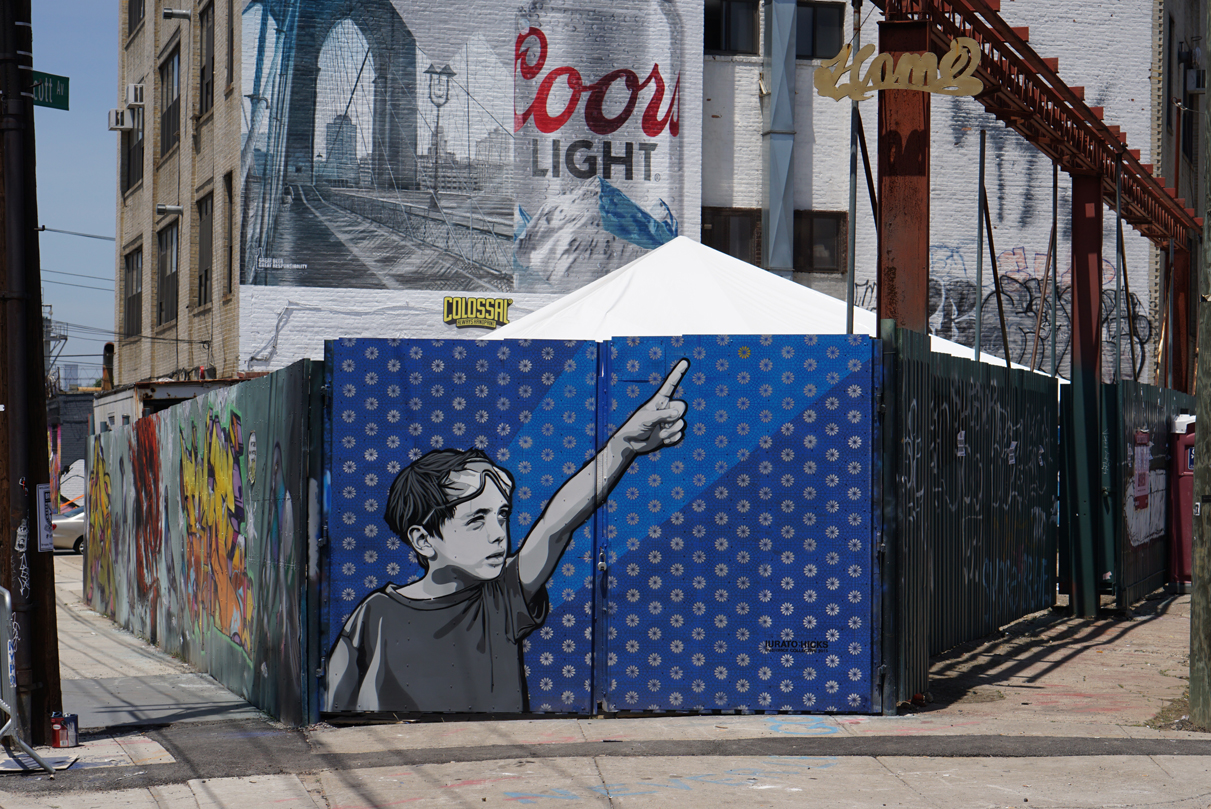
A Bushwick Collective mural by Joe Iurato at Troutman Street and St Nicholas Avenue with a large Coors billboard in the background. (photo by Joe Iurato, courtesy the artist)
The latest additions to the Bushwick Collective, the street art project founded and curated by Joe Ficalora around the intersection of Troutman Street and St Nicholas Avenue in Brooklyn, are a number of big, garish billboards. Since artists began transforming warehouse walls in the area with large-scale murals three years ago, there has been remarkably little infringement by the type of advertisements and hand-painted billboards that have overtaken many popular street art spots in Williamsburg and Greenpoint. But in recent weeks, as Bushwick Daily has pointed out, advertisements have begun appearing on the Bushwick Collective blocks, some of them installed directly atop existing murals. More [ HERE] Labels: ad creep, Brooklyn, HyperAllergic, New Advertising, public advertising, public murals, public/private, street art
|
|
|


 With advertising coming to a halt due to the coronavirus pandemic, most of the billboards across Israel have turned into empty black displays. Now a personal art project suddenly became a news item. More [HERE]